Showing posts with label Game Review. Show all posts

Saturday, June 01, 2013

Crimson Shroud


Crimson Shroud for the 3DS eShop


Designed by Yasumi  Matsuno of the Ogre Battle series & Final Fantasy Tactics fame and initially released in Level 5's anthology collection Guild 01 before making it to eshop in Europe and North America as a stand-alone download, Crimson Shroud is delightfully fun retro experience.  The game is table-top RPG, with an unseen game-master guiding the game’s players along a game board.  As an eshop title, the game isn't particularly long, but one can think of the game’s narrative as a weekend Dungeons & Dragon session with some friends.  The narrative isn’t meant to be dragged out, but is a short and simple story about a band of heroes in search of the truth behind an ancient relic called the Crimson Shroud.

For some people who are fans of RPGs as a video-game genre, the old classic table-top RPG can be something foreign, perhaps even quaint.  Matsuno’s Crimson Shroud in this sense is unashamedly retro in it use of the dice.  Everything from the effectiveness of the mage’s magic to the power of the front-line attack is determined by the die.  In doing so, the game unveils a common mechanic in many RPGs we’ve come to love since the NES days.  In almost every RPG, the random number generator plays a critical role in determining hits and misses, damage variances and critical damage probabilities. Yet in the shift from tabletop to video gaming, the trend was to hide these calculations behind the game’s visuals and attack and defend sequences.   Crimson Shroud deconstructs the RPG genre to its constituent parts by showing players how the results are arrived at with the dice roll standing in for the random number generator.  

Characters are represented as figurines on a game board
Eschewing the increasingly incomprehensible gear upgrade systems in many JRPGs, Crimson Shroud offers the ability to earn equipment and gear through random enemy battles and treasure chests with an endless supply of weapons and armor that can be upgraded by simply combining weapons of the same type together to create new and more powerful versions of the item in +1, +2 , +3 versions and so on.   As an added incentive to replay the game, upgraded gear are allowed to be carried over into a New Game+ after the game has been beaten for the first time, allowing players to experience a more difficult version of the game.

There are little touches littered throughout the game that adds a sense of whimsy and realism.  To roll the dice for example, players must use the 3DS analog slide pad to roll the dice around around imitating the motion of the hands before a dice roll.  All the units are portrayed not as fully animated avatars, but as figurines on a game board that topple over when they are killed.   While this may seem like a visual downgrade, the game uses the 3DS' 3D to great effect to craft a minimalist but seemingly real virtual game board.  The 3D depth of the games visuals gives the  figurines and the game board a sense of volume, as if the player is holding a window with the 3DS and looking in.

Launched in December 2012, the game’s surprising performance atop the Nintendo 3DS eshop charts as one of the consistently top ten most downloaded titles  is a testament that old-school doesn't necessarily mean boring or archaic.

Highly Recommended. 


Tuesday, October 09, 2012

New Super Mario Brothers 2


New Super Mario Brothers 2 for the 3DS is a joy to play.  While its DNA is very much rooted in the same New Super Mario Brothers (NSMB) game that debuted on the Nintendo DS six years ago, there are enough differences to warrant the purchase.

Interestingly, I had purchased the original NSMB on the DS, got to around world 5 and got bored of it and stopped.  It didn’t  grab me  despite being the first true side-scrolling Mario entry in a long time, though I suspect my MMO addiction at the time also took its toll.  The same thing happened with NSMB Wii. I bought it feeling obligated to due to the high praise from reviewers, but felt that it probably wasn’t for me given that its strengths were in co-op multiplayer mode.

So what made NSMB2 different?  The coins.  It’s a neat little gimmick, but the one million coin goal and the coin rush mode is an incredibly potent hook. It forced me to complete the game in the ‘story’ mode (doing so gives you a free gold flower in the coin rush modes- an invaluable advantage) and in the process it made me appreciate the tight and imaginative level designs. Coin rush is mind-numbingly addictive.  Hearing the clanging of coins and watching the coin counter grow is intoxicating, not to mention the sense of achievement when I clear a streetpassed coin rush challenge and beat someone else’s frighteningly high coin total.

In hindsight, I probably didn’t give the original NSMB on the DS and NSMB Wii a fair shake (pun intended) , and this is where I fundamentally disagree with critics of New Super Mario Brothers 2.  While all three games shares a common DNA and all had tight well designed levels, NSMB 2 isn't just a rehash.  The original was the kick-off to the franchise. The Wii game was multiplayer centric.  This entry on the 3DS is aimed squarely at a gamers’ need to achieve, to get the high score and to find everything.    Coin rush isn’t just about randomly getting coins and clearing a level on a small time budget, it’s about earning coins efficiently.  Do I jump around near the beginning to grab the floating coins and hit the blocks?  Or do I skip those and rush right in spend my time gabbing higher yield but more difficult to grab gold medallions instead?  The coin rush mode introduces rationing and scarcity of time, highlighting trade-offs and opportunity costs to maximizing the amount of coins one can collect in each carefully crafted level.  Coin rush also rewards repeated play and familiarity to the randomly selected levels used in coin rush.  Knowing each of the three levels in a coin rush inside and out is also crucial to getting the highest coin totals as collecting each of the three gold medallions yields exponentially more coins, and the 1up Mushrooms in the standard game turn into golden mushrooms that reward 50 or 100 coins in coin rush mode.

Revisiting  the DS original, it becomes plainly clear that  NSMB on the DS is several steps behind NSMB 2.  In the DS original Mario has fewer power ups and moves, the visuals are full of pre-rendered, pre-baked sprites to keep a consistent visual look on a more limited hardware, and the game doesn’t even scroll or animate as smoothly.  New Super Mario Brothers 2 in comparison had fluid animations, better quality artwork, including a neat use of the 3D slider to interpolate depth-of-field backgrounds, and power ups that I enjoy, especially the gold fireflower.

It is true that the leap from NSMB to NSMB 2 isn't in the order of say going from Super Mario Brothers to Super Mario Brothers 3, and that is a legitimate complaint for those who felt discouraged that Nintendo insisted on keeping the same (even if improved) aesthetic style on the 3DS.  But to me, that’s not a rehash, there’s enough there for it to be considered a true sequel.

If there is one thing I would knock it is how the streetpass system works.  While there is plenty of room to store streetpassed Coin-rush levels and even favourite streetpassed levels you like to avoid them being overwritten. Each player only has room for 1 coin-rush pack that they can share with others via streetpass.  Want to show off your high coin run on a relatively easy Mushroom Pack (stages randomly selected from Worlds 1-2)? Need to use your one slot for streetpassing.  Want to show off your leet skills on a difficult coin rush challenge? Need to use your one slot.  Want to show the guy you streetpass every morning you beat his 13,000 coin total? Need to use your one slot for streetpassing.  Also, outside of your one save slot for streetpassing, there’s no way to save and archive interesting and fun coin rush packs the game creates for you unless someone else you streetpassed sends it back to you.  I wish there is a more robust option here, perhaps three slots to allow players to  save a selection of coin rush stages. That said, it is a minor quibble.  If you can streetpass someone daily or even weekly, there’s plenty to do in terms of beating other people’s coin rush records.

New Super Mario Brothers 2 is a great game and one of the finest platformers out there today. It is also a game that knows its platform very well, playing to the 3DS’ unique features, including 3D, while avoiding its weaknesses, including 3D.   Each level is no more than three to five minutes long, and coin rush modes randomly string three of these levels together.  I’m amazed by how well the game works around rationed time.  If I have 20 minutes here or there, I can do a quick coin rush or two and before I know it, my time is up.  

Fun Fact: World Wide coin total sits at 184 billion and counting, updated every few seconds.   


Saturday, September 15, 2012

The Last Story –First Impressions


Five hours in, I can’t help but think to myself that The Last Story is very much the Final Fantasy game we deserve, but the game the Square-Enix has abandoned.   There are shades and echoes from previous Final Fantasy games everywhere for anyone who is familiar with the franchise. It plays and feels like Final Fantasy in all but name. The character archetypes pick up right where Hironobu Sakaguchi left off in Final Fantasy X.   Interestingly enough, the crest on The Last Story logo has a set of roman numerals around its edge numbering from I , II, III and ending in X. This would seem to imply that in Sakaguchi’s mind, this would be his 11th single-player entry into the Final Fantasy series.

The castle town in Lazulis reminds me of San d’Oria in Final Fantasy XI and Alexandria in Final Fantasy IX, a bustling but quaint medieval town.  The game design borrows heavily from Final Fantasy XI and XII with a massive and beautifully rendered 3D world filled with NPCs and a really nice depth of field effect for objects , NPCs and allies.  There are open ended interludes between narrative segments to allow for questing, weapons upgrading and earning gold. So much so that there is a MMO feel to this offline game given all the NPC quests, looting and gear grinding to be had.   In fact, The Last Story has an on-line mode where players can play co-operatively and competitively. I haven’t it tried yet, but I assume gold and loot earned can be carried over to the main game.

The battle system isn’t turn based, but an evolved  RTB (real-time battle) system found in Final Fantasy XI and XII with a stronger emphasis on tactical combat and strategy.  As a result, the camera system in The Last Story can be a little jumpy because movement, use of the landscape can often lead the camera astray. I much prefer the more restrained ‘third person’ camera in  Final Fantasy XI and XII.

It’s a great thing Xseed was able to bring this title to North America, and they did it in style, complete with a faux-book jacket housing the Wii game and a slim but worthwhile artbook.  Pre-orders (I got mine via Amazon) also had a bonus CD included, with selected tracks from compositions by none other than Final Fantasy's Nobuo Uematsu.

From what I’ve seen, heard and played of The Last Story so far, it feels like the start to a wonderful game that harkens back to the golden age of Square RPGs in the mid to late 90s, much like the other late release on the Wii, Xenoblade.  I wouldn’t have it any other way.


Sunday, August 26, 2012

We chose to go the Moon...


Kerbal Space Program (KSP) is an indie  PC/MAC space sim that is part lego, part science project, and part physics class. There’s a free demo out.  The game isn’t complete yet, and is in heavy development but the team is already accepting $18 donations for a chance at getting future updates (demo versions stay at v0.13 with the current build at 0.16)

The premise is simple.  Build a rocket ship.  The Alpha release comes with liquid and solid fuel stages, a command module, a stock parachute and de-couplers for those awesome views of rockets jettisoning unused parts.

Players can build rockets of any configuration, but basic laws of physics must be obeyed.  Unstable rockets will fall apart or spin out of control and explode.  Admittedly, killing the Rabbids look-alikes is part of the fun, but this ‘game’ has a serious side.  Watching rockets soar gracefully into the sky aside, it is also great lesson on basic principles of Newtonian physics.

 Orbiting a spacecraft is a small exercise in basic orbital mechanics. Who would have thought there was so much involved in something most people assume would be easy.  I mean it always looked so easy in the movies!  In actuality, putting a spacecraft  into orbit is a tad bit more complicated than stringing a bunch of rockets together and letting it rip.  Too much thrust and chances are your spacecraft will fly into space and never  return, too little thrust and the rocket flies up through the atmosphere and back down in a giant parabolic U shape, not unlike what one might see from bottle rockets or  homemade rockets.  Orbiting requires reaching space with enough fuel left to level out the spacecraft, shutting off the engines and waiting for the craft to reach apogee before firing the rockets once more to turn the parabolic trajectory of a rocket into a circular orbit around the planet.

Advanced players have already landed on the Mun of Kerbal (the Moon, get it?) from using the stock parts provided in the (free) Alpha release, despite there being no lunar lander included.  I can only imagine what else might be instore from the full release.  A mission to Mars and the outer solar system?.   I need to play some more before deciding on spending the dollars to get the non-demo version.  Suffice to say that I am loving the demo so far.

While I sit at home with a sore ankle, I have decided to launch my own space program.  The goal is to reach the Mun (Moon).  The first step is to successfully orbit Kerbal several times.  I have already recorded one success so far, with my very own Tartarus II mk 3 rocket.

Next step is for a few more launches and successful orbits and to land safely back on Kerbal.  After that, I need to design a new rocket for the Mun.  The Tartarus III.

One small step for man, One giant leap for mankind.

Thursday, July 05, 2012

Theatrhythm : Final Fantasy


The Final Fantasy brand may be struggling elsewhere but Theatrhythm: Final Fantasy reminds us why the brand has endured for so long.

Bringing a large repertoire of battle, theme, and event music from the thirteen Final Fantasy games the game is easily one of the best entries to the brand.  Developed by IndiesZero (Electroplankton, Game Center CX) Theatrhythm has the right mix of challenge while remaining accessible to more casual players.  The format is deceptively simple, yet hopelessly addicting as you try to redo a track to get a perfect score or to raise your average.  The nostalgia factor is excellent especially for fans of many of the Final Fantasy entries. 
Square-Enix has kept the music faithful to the source.  8 and 16-bit Final Fantasies sound like they were indeed playing back from the NES/SNES and full on operatic scores are true to form.  They even went so far as to use in-game footage of the event music stages for the older Final Fantasy entries, eschewing the new CG cinematics for remakes of entries like Final Fantasy IV.

The basic premise of the game is for players to play through each of the 13 Final Fantasy scores, consisting of an opening/ending theme where players can skip or tap the crystal to earn notes (the game’s currency).  The real meat of the game however are the  three stage types: Battle, Event and Field Music stages.  Each stage type has their own gameplay quirk, but generally involves timed tapping, flicking in specific direction and holding on the touchscreen and a combination of all three for some really intense and complex sets.   This may sound simple but when the difficulty ramps up, you’ll be using these basic skills in rapid fire succession.  The game is definitely designed with a stylus in mind and I find the large pen-like stylus of my DSiXL a better fit for the skinny telescopic stylus of my 3DS.

To clear the stages, players create a party of four drawn from a collection of key characters from all 13 Final Fantasy entries.  The character design is a homage to the tradition of rendering the characters in Chibi (small) format  as a companion to character designer Yoshitaka Amano’s ‘official’ designs during Final Fantasy entries in the SuperFamicom Era. 

There is an experience system. Your party ‘levels up’ as you clear stages. Landing lots of ‘Criticals’ and generally not missing any of the notes will let you clear more enemies on screen in a set musical piece. Clearing more enemies means more EXP, which allows you to equip spells, abilities and increase stats which will help you survive even longer on the really tough challenges such as the Chaos Shrine stages.  The key is that although one could complete a music stage, playing it with levelled up characters and the right abilities will allow players to clear more enemies and in the battle music stages kill boss characters, which drops more items and experience points.

As noted earlier, the game includes Chaos Shrine stages which is a separate area from the main game. These stages mixes 2 themes randomly, usually a field and battle music set,  but are significantly harder.   Clearing Chaos Stages earns players access to new randomly generated chaos stages which can then be exchanged via Streetpass.  In a bit of a headscratcher, players must clear at least 1 Chaos Stage to access Streetpass.  This seems like an unusual hurdle to put infront of players given the relative difficulty of clearing the first set. 

In addition to the music game, there is also a fully featured theatre, a card collecting side-game, and a music player.  Finally Theatrhythm has a DLC feature. On launch 8 of the 50 planned DLC songs are available for purchase at 0.99  per track. A relatively good bargain given these are real DLCs and the download are substantial including brand new scenes, and of course, the music track itself. 

Coming from someone who isn’t and was never big into rhythm games, I have no reservations in saying that I highly recommend Theatrhythm: Final Fantasy.  Pick this up if you’re a Final Fantasy fan.

Saturday, June 16, 2012

A meditation on Civilization V


In the opening to his book Colossus: The Rise and Fall of the American Empire (2004), historian Niall Ferguson recounts his son playing Age of Empires.  “For several months my own ten-year-old son was all but addicted to it.  It’s organizing principle is that the history of the world is the history of imperial conflict.”  More recently, Ferguson described  the shifting world order and the evolving relationship between the United States and China as “two great tectonic plates ... on the move” and in his book The Ascent of Money (2008) described the easy  marriage and alignment/merger of the geopolitical tectonic plates of China and America as a strange geopolitical continent called Chimerica.  A spendthrift West Chimerica spending the money saved in East Chimerica, west and east interdependent just as a national economy relies on the population centers to consume the products of its industrial base.

Ferguson’s concept of nations as empires and history as that of Imperial history is thus in sync with the Civilization games.  The Civilization franchise have operated on similar concepts in its unabashed view of history through the prism of empire and the sweep of history as the rise and fall of empires.

While the last three Civilization games have improved the franchise and introduced concepts such as cultural borders, scarcity of resources, religion, complex trade deals and factions in the games were all called 'Empires', Civilization V (Civ5) is the first in the franchise to begin to attempt to capture the essence of empires as tectonic plates moving apart, past, against and directly toward each other, complete with fault lines building stressors that lead to earthquakes which inevitably reshape entire world orders.

In viewing empires as geopolitical tectonic plates, with a mass and direction of movement, Civ5 attempts to integrate the concept of national interest in terms the game can understand.  Whereas previous entries created a standard playbook followed by all AI civilizations where all the civilizations essentially played similarly and  valued expansion above all else for no other reason than size, with a vague goal towards getting as large as possible, Civ5 steers AI civilizations into various distinct flavours consistent with each civilization’s strengths and the historical actions of their leaders.  Some, like Hiawatha, or Ramses II might be peaceable and friendly if their territory and right to exist is respected. These are builders who more often than not will sit peacefully in their starting location for millennia happily building up major monuments and infrastructure in and around their capital cities.  Others like Alexander the Great and Montezuma are bloodthirsty conquerors eager for war and expansion at the earliest possible date.

Each leader thus have a set of interests and priorities that have to be put into consideration when forming alliances.  A faraway warmonger like Alexander or Bismarck might be useful ally as they are unlikely to immediately covet your lands. Similarly, it is also viable for like minded civilizations to form coalitions denouncing the aggressive expansion of a warmonger, with each common denunciation reinforcing the common bonds of friendship and the recognition that each state in the grouping shares a common national interest in their dislike or fear of ‘the enemy’ civilization(s).  Finally, each Civilization will develop and interact with city states they meet.  These leaders may forge alliances and pledges of protection with these city states and trying to attack, conquer or wrest control of these city states from them through alliances of your own could impact your diplomatic relations with the AI leaders.

As such, the tectonic plates of empires are formed.  Each leader brings to the table a grand strategy on how they want to optimally play the game.   Where empires meet and become rivals due to a common strategy, the empires inevitably clash. Wars in Civ5 thus have the narrative underpinning of clashing national interests.  Whereas wars in previous games often came down to an AI being bribed by someone else, or an AI rolling a dice on who to attack next, the narrative in Civ5 is much more grounded in terms of geopolitical conflicts with a basis that is consistent and related to the realities of the game being played.

There are other changes of as well.  In the previous iteration of the game, skilfully maximizing the production of science, hammers and gold were an implied premise. Players can achieve pareto efficiency, through fiddling with citizens working tiles and the tax slider and extract extra hammers, gold or science that would have otherwise been lost in the void of the game maths through rounding or culling of surplus values.  Civ5 omits the tax slider in favour of cities performing at peak efficiency given a specific focus (food,wealth,production) with the maximization shifted towards the management of international relations by maximizing diplomacy and a player's 'influence' in the word to exercise soft-power.

The last significant change is the 1 Unit Per Tile (1UPT) system where in previous games players can simply put all their units into a single stack and move them around.  Though controversial, 1UPT  is widely popular in the community as adding depth and freshness to the game.  There is now a reason in placing rifles infront of cannons. Strategic placement of troops and use of terrain matter in Civ5. Gameplay elements aside, there’s also a point for vanity as one reviews their grand armee before an invasion.

Civilization V is not without its detractors.  The initial release was rushed and buggy with an incomplete AI and diplomatic systems, to the point where none of the things I’ve described today was possible at release.  But after a year of patching and with the upcoming Gods & Kings expansion, the stage is set for Civ5 to live up to its potential.

In Civ5, the games designers, Ed Beach et al, have shifted the complexity of the game from managing small details like stacks, sliders and tiles being worked to the grand strategy of positioning a civilization in the cut throat geopolitical world.  

“The nuanced approach to history and complicated demands appealed to Beach's sensibilities,”  noted a profile on Civ5 AI programmer and Gods & Kings lead designer Ed Beach.  “A self-professed strategy game enthusiast from the age of 10, Beach likes games where the action is not always straight forward combat, and the players are free to form secret alliances and negotiate their way to victory. Where the sides are uneven, and a player's ability to rise above the challenges can lead him to victory.”

Whereas surviving against a diplomatically delicate world was the preserve of elite challenge-players playing in the highest difficulty levels in past iterations of Civilization, and often it only meant finding ways to fight multiple wars at the same time,  Civ5 brings the challenge of managing a delicate diplomatic game, both war and peace and all of the intrigue in-between, to players of a broader range of skill levels.  Any player playing a difficulty level matched to their ability should be able to experience the feel of steering one’s own tectonic empire in the messy and sometimes hostile geopoloticial world where balance of power and realpolitik rules.


Saturday, May 12, 2012

The Last Window


After bursting to the scene in 2005 with Another Code/Trace Memory,  CiNG’s adventure games on the DS promised a new era of adventure games on a major game platform.  By 2010 however, CiNG ran into financial difficulties and filed for bankruptcy just as their last game, The Nintendo published The Last Window: Secret of the Cape West saw release in EU markets after a release in Japan.

Either due to CiNG’s bankruptcy or Nintendo of America’s conservative release schedule, CiNG’s swan song would not see a North American release, much to the dismay of adventure fans stateside. Regardless of the reasoning, the circumstances around the game’s release is worthy of CiNG’s pedigree of coincidental storytelling.    The Last Window is an aptly named title for it marked the end of the Touch! Generations period for Nintendo and the burst of energy that emerged from the company during the first few years of the Nintendo DS.  It was our last window into that period.

Despite these hurdles, North American fans can still enjoy the game by importing the European release of the game, localized in English, thanks to the decision not to saddle the Nintendo DS with any region locking at the time it was designed.

The Last Window continues the story of Kyle Hyde, the protagonist from Hotel Dusk Room 215.   Like Hotel Dusk, the game opens around Christmas.  It is 1980 and it has been a year since the events at Hotel Dusk.  Kyle Hyde wakes up from an afternoon of napping only to be chewed out and fired by his boss, Ed Vincent, an ex-LAPD cop and owner of Red Crown, a company specializing in finding things for clients while using a door-to-door sales business as a front.
The unemployed Kyle returns home at the Cape West apartments only to find the landlord sent out notices a week prior about an imminent eviction by the end of the month as the building has been sold.   Kyle is then confronted with a rogue order sent to his door directly by an unknown client asking him to recover the mysterious diamond the Scarlet Star which disappeared from Cape West 25 years ago.  His interest piqued, he slowly unravels the secrets hidden in the apartment complex he has lived in for four years.  A story that would ultimately span 25 years, involve 2 murders and a notorious crime syndicate.

The game’s scale is ambitious, spanning more than week there is a lot more to do and examine and the mystery is far more layered and complex.  Scenario designer Rika Suzuki maintains the hard-boiled noir feel of Hotel Dusk throughout this adventure. Compared to Hotel Dusk,  The Last Window does suffer due to its scope and the game feels a little less focused in the middle part of the adventure.  This may be in part due to the game structure which spanned multiple days and lacking in end of chapter interrogations like in Hotel Dusk which is structurally similar to ‘boss battles’ found in traditional games.  The Last Window eschews from this formula and as a result the pacing didn’t feel as tight.  I was certainly much more enthused to power through several chapters at a time in Hotel Dusk in 2007.

The game’s core mechanics remain in-tact from Hotel Dusk.  It is divided into a free mode where players explore their environs, interact with objects and solve puzzles and a conversation mode where the story is revealed, players ask questions and the game’s equivalent of ‘boss battles’ occurs in interrogation sections though as noted, these don’t necessarily occur at the end of each chapter but are rather placed where the story requires it.   In Chapter I, there is some hand holding features added explaining how the interface works, which is a nice addition.   Furthermore, players can more easily avoid a red wave during questioning by asking the right questions simply by keeping the overall narrative arc in mind and using common sense.   Avoiding a red wave was crucial to earning a ‘good ending’ in Hotel Dusk, but avoiding them  in that game often required memorization of the right questions to ask as they  often weren’t obvious in the context of the story but were native to the individual quirks of each character as written by the scenario writer.

The Last Window reuses the same engine from Hotel Dusk, and the interior environs are rendered with the same pleasing watercolour motif.   Characters are animated in a sketch-book style reminiscent of A-HA music video.  To enhance the authenticity of the visuals, CiNG used models as references and rotoscoped the hand drawn animations overtop of them.  This explains the personalities of each of the game’s characters.  The way they hang their head, their smirks, the frown lines on their faces and way they smile give away the personalities of each individual. Each is unique and distinct and there is an authenticity their expressions that lend weight to the story.  The game also improves on Hotel Dusk.  The Last Window features animated title sequence with watercolor studies of a fictional downtown LA  in the 1950s, 60s and 1980 with Hotel Cape West.   There are also animated sequences bridging between chapters.  Improving on the  cramped pancake architecture of Hotel Dusk,  the architecture of the Cape West apartments feature a roof top sequence set in the middle of downtown LA, and an expansive lobby with a four-story tall glass window, providing a sense of scale as Kyle Hyde traverses the four floors of the Hotel..

The soundtrack by Satoshi Okubo is solid, if perhaps less charming than in Hotel Dusk.   It lacks the recognizable leitmotif’s of Hotel Dusk , instead the game ties themes to different parts of the  apartment building.  Even then there isn’t the immediately recognizable and catchy ‘Hangover Blues’, Dunning Smith’s theme, from Hotel Dusk.  That is not to say there aren’t good music in the game.  The universe Rika Suzuki and the team at CiNG created includes fictional background characters like jewellers, politicians and artists that add depth to the story.  In The Last Window, music is part of the story.  Whereas the fictional artist Osterzone in Hotel Dusk and his painting ‘Angel Opening a Door’ drove me to Google Osterzone when the game was new (something I would not recommend for neophytes who want to avoid spoilers),  The Last Window’s equivalent to ‘Angel Opening a Door’,  a theme called ‘ Promise’ was very clearly something made just for the game due to the MIDI treatment. 

The Last Window is a fitting end to something that started out with so much promise.  Along with Hotel Dusk  and Trace Memory, the CiNG trilogy on the Nintendo DS are stylistically unique titles.  They offer engrossing stories with interesting twists and turns, even if some of the coincidences prove a little too coincidental.  (d)

Monday, February 05, 2007

Hotel Dusk – Final Impressions

I blogged about the then upcoming Hotel Dusk a month ago and its release has come and gone. Although the game appears to have a limit print run, I was able to snag a copy at my local EB in late January.

Hotel Dusk Room 215, is in a word, brilliant. It is a classic noir tale spun into a masterfully designed DS game. The game isn’t perfect. Sprinkled throughout are a series of puzzles each with their own DS-specific ‘touch screen’ interface. They are quite literally mini-touch games in of themselves without hints as to how to control them. This ultimately leads to a lot of trial and error that can be frustrating.

The game’s strengths however is in its story telling and writing. Each of the more than 10 characters in the game has their own personality. The amount of text in this game is truly staggering. There are branching conversation paths, objects that can be examined and conversations with Kyle (the protagonist)’s home office which drives the story forward and keep the various disparate threads together.

Hotel Dusk takes place in the span of less than 10 hours inside on run-down hotel, and in this context, the scale of the game is quite huge. The hotel is slowly unlocked room to room and the chapter system breaks down the game narrative into hour long or half-hour long chunks. It truly is a lot like a ‘24’ style game, albeit players can spend as much time as they need on a chapter.

Although Kyle Hyde’s drive to find the partner he shot 3 years ago (Bradley) is what kicks off the story, he and the player must ultimately unravel the secrets within the Hotel Dusk to complete the game. The writers managed to weave a tale so compelling that with few exceptions, each secret unraveled leads the player (and Kyle) one step closer to solving the mystery behind Bradley and his involvement with a shady art-theft ring called Nile.

The game also features a very impressive visual style. The visuals are a mixture of watercolor studies reminiscent of architectural or industrial design and pencil on paper sketchpad animation. There’s also a fairly sturdy 3-D engine representing the entirety of the hotel environment players can explore. The 3-D environments themselves are textured in a watercolor look with the colors fading into white on the edges of a surface. The walls and floors also feature a distinctive gradient look as if painted over repeatedly by an unseen artist trying to create lighting through darker and softer tones of a hue.

The game’s graphical star however is the character animations. Oft referred to as being inspired by A-HA music video, I prefer to describe them as being animated sketchpad drawings. The ‘sketch’ look and the twitchy wavy lines lends the character life, even as the characters are standing still. Each of the characters also have a full repertoire of animated expressions, from glee, sadness, anger, denial among others which aids in characterization and makes this fairly 'old school' way of doing things superior to 3-D facial models or other more advanced techniques. The nuances that an animated character portrait allows for makes this game's characters seem authentic.

Hotel Dusk is a fantastic mystery novel in game form and it’s well worth its low price. Grab this game when you find it in stores. It probably won’t be very plentiful in used stores in the future given its apparent limited availability. If you want to know more about this game, check out its official website.

Thursday, January 11, 2007

Twilight Princess - A Visual Game


40 hours in, The Legend of Zelda: Twilight Princess is just as good as I had imagined. It is rare in this day and age for hyped products (and Zelda certainly is hyped at least among gamers) to live up to expectations. The game isn’t perfect, and I had wished Miyamoto had listened to his team members for creating a Twilight Princess SP version for Wii owners, but that's really a minor quibble and gives me something to look forward to in their next Wii-specific Zelda title.

The challenge is there, and obviously this game is not ‘hardcore’ hard, it’s accessible enough for any able men and women (also children, never forget them) who are willing to tackle this gargantuan quest. My early worries about the ‘standard’ right-handed Wii-mote controls being impossible for me as a lefty has been disproved. But then again I’m a life long right-handed mouse user and found pointing the Wiimote right handed to be very natural and intuitive.

But what I want to talk about today is the look of the game. Visually, everything I had hoped in my wildest dreams as a teenager 10 years ago writing for Nintendojo with Michael Veroni has been put into the game. In 1997, before The Ocarina of Time was released, my only frame of reference for how a it would feel to play a 3-D Zelda game was to look at some of the production paintings for A Link to the Past and the official art found in the Nintendo Power Player’s Guides.


Several images have always stuck with me. There was the picture of Link standing on top of Death Mountain looking down at Hyrule below, and perhaps the most striking image is that of a the Master Sword resting on its pedestal deep in the a verdant forest sanctuary, with beans of sunlight filtering through the forest canopy. Then there were the images from the official player’s guides that were not only artistically beautiful but embodied the look and feel of a true 3-D Zelda game. The scale of the images were epic and cinematic. I remember the picture of Link climbing on top of a rock outcrop only to discover the entrance to the a temple ruin and another one of Link hiding behind a half broken pillar, bow ready, while Ganon in his beast form stalks him.

In 3-D however, I was never quite pleased with Ocarina of Time’s handling of many of Zelda’s elements. The famous Lost Woods was turned into a series of boxed rooms with forest wall textures, and the Master Sword was found in the temple of time instead. In fact, while Ocarina of Time was visually great in 1998, many of the epic images I had of what a Zelda game should look like in 3-D were never realized. In Wind Waker (2003), the toonshaded look and limited selection of dungeons as well as the game's context (sailing between islands) failed to tap the GameCube's power to project the epic images of the artwork that have always stuck with me.

Thankfully it is in Twilight Princess that series producer Shigeru Miyamoto and director Eiji Aonuma finally put many of the elements into place. The Master Sword can now be found in its home inside the great forests of Hyrule. The landscapes of Hyrule have finally come alive, bloom lighting and all.

Thursday, January 04, 2007

Hotel Dusk


If you were to ask a hardcore gamer why they think the Nintendo DS is such a huge hit in Japan and is increasingly pulling away from its rival in the West, they will probably point to the new Mario game, lots of software for big name third parties (specially Square-Enix), and non-games, a new genre of games loosely connected as games that appeal to people who don’t normally play games which has expanded the market and allowed Nintendo to tap into entire demographics (older gamers, girls and women).

The other side of the story however is a growing library of demographic specific titles such as the upcoming Hotel Dusk: Room 215 (known as Wish Room in Japan) which brings back the point and click style ‘adventure’ games that were all the rage on the PCs in the early to mid 90s.

The move over to massively multiplayer and first person games on the PC have driven out the franchise, and adventure games have never found a home on consoles, which in the 90s, at least in the west, was dominated largely by twitch platformers and combat games.

Hotel Dusk is a mystery adventure story set in America during the late 70s and is developed by a small Japanese development house called CING for Nintendo. It features an eye catchy art style with game’s cast of characters portrayed in a pencil on paper 'flip book' animation style. The exploring in contrast is done inside richly textured interactive 3-D environments. This game is full of atmosphere. I love the setting, it has that 80s-style Hollywood noir movie feel to it.

As an aside, CING also developed the relatively short adventure, Trace Memory for Nintendo as part of the DS launch library. The game was criticized at the time for being too simple and short and may have been targeted to a younger audience. As the DS audience has grown however, and Nintendo found many older gamers have picked up a DS, Hotel Dusk appears to be more compatible with my tastes.

Catch the Japanese trailer here. If you have a good eye, you can also catch a glimpse of the De Niro look-alike.


Monday, July 10, 2006

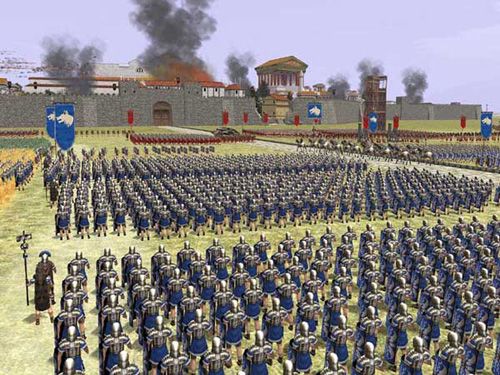
Total War: Rome

One of the pleasures of picking up well-received PC games a year after its release is the ability to pick up their ‘Gold Editions’ which usually include the 1st expansion and a patched vanilla game and a substantial discount.

This is what I did with Rome: Total War. I’ve seen it on the shelves for some time, often retailing for as much as $60.00 Canadian last year. This past Wednesday, I walk into our local Future Shop with a mission to find this game. And luckily enough for me, there was one copy of the game left, and it was the Gold Edition, with the Barbarian Invasion included expansion for considerably less than the full priced versions of the vanilla game I saw on store shelves last year.

I’m no stranger to the Total War franchise. I had downloaded an early demo of Shogun: Total War several years ago and was impressed with its engine. In fact, when I bought my new computer in 2003, the first game I bought for it was Shogun, then already deeply discounted. Ultimately, Shogun: Total War was graphically impressive but slightly clunky, and it was still largely a twitch based RTS type strategy game with a glorified turn based campaign map tacked on.

Rome is a vastly improved game. The campaign scenario is a fleshed out turn based strategy game in the vein of Risk or Sid Meier’s Civilization games, while the individual battles themselves are in real-time. The player are then given the option to either auto-resolve battles or to fight them out and similarly on the macro side of empire management, players can also choose to automate all their cities and focus only on moving armies and fighting. This gives players a range of choice on how to manage their factions in the campaign game.

No game has married the strategic scale of a turn-based game with the tactical nature of RTS games as well as Rome: Total War has done. As someone who enjoyed games like StarCraft more for its co-operative play, rather than the frantic nature of a typical RTS death match game, I really appreciate the real-time strategy battles in this game. Fast movement is replaced with realistic movement. There is even a pause button for players to pause the game and give their individual units commands. And the real-time battles themselves play out realistically. Ordering a unit of Centurions to march from the left flank of my battle line to the right will take time, even if they are running at full speed.

Further more, unlike your typical history based RTS games such as the Rise of Nations and Age of Empires games, the separation between a campaign map and a tactical battle map also separates economic (macro) empire management from tactical battle management. Fighting a battle then having to zoom across the map to ‘home base’ to move idle workers to a logging point is a non-issue in Rome. I could only wish more RTS games masquerading as history simulations should take note.

The realism injected into the battles result in very well paced battles and the tactical nature of the fight itself is enhanced. Instead of degenerating into a mass of units dying, there is still a lot of management that can be done even when the bulk of two armies clash. Rarely do I find myself struggling to command my units, as is usually the case with most RTS games, when there are too many units to manage and too much going on.
Supported by an impressive 3-D engine and an epic Hans Zimmer inspired soundtrack by composer Jeff van Dyck, the battles themselves become a kind of beautiful cinematic experience of battle formations, clashing melee units and cavalry charges. Students of history will appreciate this game for giving them a view and control into one of the great epochs of history, despite some obvious deviations from history.


Monday, October 17, 2005

Nintendogs Day 4


Nintendogs is a great game. As I noted in my earlier post, the game sold 200,000 units in its first week in North America, it sold a further 250,000 units in all of September, putting its cumulative total on September 31st at 450,000 units sold. In Japan the game’s sell through is fast approaching 700,000 units and the game did reasonably well in Europe after its late launch with 150,000 units sold.

I was lucky enough to not only be alive but mentally cogent and aware when Bandai’s Tamagotchi virtual pet craze swept through North America in the late 90s. Heck, I actually had one of those things, or it could have been a cheap knock off…well it doesn’t matter. The point is virtual pet games have been a mainstay for many years now.

It’s surprising that after all these years, virtual pet sims can still surprise us when many thought the fad had passed. I was never big on the virtual pet phenomenon the first time around and for me it was the simple reason of design. The first generation of virtual pets were dumb, stupid and got boring quickly. My Tamagotchi pet went uncared for after about two days, and the Dogs and Cats type PC virtual pet games looked interesting but were more like advanced versions of Tamagotchi games, only with prettier graphics.

This brings me back to my opening paragraph. Why all this interest in a dog/pet simulator now? The answer is quite simple. Nintendogs isn’t a cheap high margin $30 toy. Nor is it a half hearted one-sized fits all PC game that tries to shoehorn the concept of a virtual pet game into an existing platform.

Nintendogs is built for the Nintendo DS. The two native features on the DS, the touch screen and the microphone makes a world of difference. Players no longer need to learn complicated button combinations to access the right menu to play, pet or feed their pets. With Nintendogs, what you see is what you get. If I see the dog, I can reach out pet it with the stylus. Rather than accessing a command to call the dog to attention, players call out the dog’s name.

And the voice recognition aspect of the game the real deal sealer for me. While the voice recognition software is far from perfect, it works well. The dog will learn the user’s voice and learn its name after a few tries. A few days on, even the slightest call will get the dog to react to its name and it will leap happily towards me.

The harder part is getting it to recognize all the different commands for tricks and getting it to remember everything. This may be due in part to the built-in mic being place slightly off centre while the natural tendency of the player is to speak to the puppy face to face. The programmers at Nintendo also implemented a nice ‘real-life’ dilemma to players. Rather than having a robot dog for a pet where everything taught is learned and mirrored, the dogs in Nintendogs forget tricks, mix them up, and will sometimes stubbornly refuse to participate in training when they are tired or hungry.

For me, the greatest innovation with Nintendogs isn’t the idea of the virtual pet, but rather the idea of a virtual life living inside a bundle of chips, motherboards and electrons. This effect on the heart and brain is something the clunky Tamagotchi and the first generation virtual pet software never truly achieved. Nintendo had really nailed down the illusion of a real living pet with in this game, sans the physical touching, although the touch screen is a welcome substitute.

And for all the flack Nintendo get about how the DS is underpowered, Nintendogs is a great game to play and look at. The 3-D world is silky smooth, perfectly textured and dare I say beautiful. It is all seen through the dog’s eye view of course. The dogs are slightly stylized but look realistic and do not betray the real puppies they are based on. It is also clear Nintendo designers studied real dogs to capture how they play, sleep, react to toys and even how they go to the toilet. Everything is modeled with a kind of whimsy and realism that makes coming home to the game such a great thing. And finally, the game isn’t time consuming. Fifteen minutes here and there is enough to maintain a healthy dog and keep the dog trained for the game’s various competitions.