Monday, May 21, 2012

DSi XL at Last!


Left: 3DS Right: DSiXL

As of May 20th the DSiXL had a price cut to $129.99, after a period of nearly a year when it was at price parity with a much more feature rich 3DS;  a platform that can play games not compatible with the DS/DSLite/DSi line. 

I’ve always wanted a DSiXL, the large bright screen, comfy pen sized stylus and long hour battery life lasting up to 17 hours had been well received by gamers and the unit did not disappoint.

Released in 2010 and positioned as a large DSi for adult and older 'casuals' to use, the DSiXL also has a fairly good following among gamers looking for a larger screen DS to play at home, where portability is less of an issue.

The unit feels great on my hands and it combines features of the DSi and DSLite into one unit. It has the matte finish of the DSi, although the finish on the XL is much more textures, while retaining the glossy finger print magnet of the DSLite on the unit’s top side.

The first thing you’ll notice is that navigating touch games with the pen sized stylus feels amazing, and things like writing my name in the pack-in Brain Age  DSiWare titles feels much better as the much larger surface area of the touch screen allows for much more nuance in writing.

The next thing I did was to fire up The Legend of Zelda: Phantom Hourglass, and the game looks absolutely fantastic on the DSiXL. It is incredibly vibrant and bright.  The first thing I notice moving from the 3DS, at maximum brightness with power-save turned off to the DSiXL screen is that the 3DS screen looks much dimmer by comparison. It looks likethe DSiXL will be my DS unit to finish up some of the many games on my DS that I never got around to playing or completing.

P.S. It’s interesting to note that the ClubNintendo questionnaire I filled out had 2 extra questions.  It asked consumers why the picked the DSiXL over the 3DS and if they ever considered the 3DS at all.  This was likely added when both the DSiXL and the 3DS were at price parity.

Not surprising that Nintendo would be interested to know considering the DS (well most models sold in the past year had been the DSi and DSiXL)  continue to do well inspite  of the newer model 3DS whereas DS sales have all but collapsed in Japan as consumers have bought the 3DS instead.

Monday, May 14, 2012

Three Reasons for Multiple Wii U Tablet Support


With just under a month to go before E3,  Nintendo’s plans for the Wii U and its tablet controller is very much set in stone.

It is however still helpful to explore the reasons why supporting more than 1 Wii U Tablet henceforth referred to as the uPad is critical to the company’s future and the future success of the Wii U.

Before we launch into the discussion it is worth pointing out the speculated specifications of the uPad.  The screen is widely believed be 854x480  6.2 inch touchscreen with a  16:9 (widescreen)  orientation with a fairly decent 158 dpi, putting it in range of the old pre-retina iPhone and ahead of the iPad 2.

Most people are speculating the uPad itself will be a fairly barebones device with a screen, gyro sensor, IR, near field communications (NFC), accelerometer, a screen. li-ion batteries, and some basic computing to receive and output the video stream.  It is NOT expected to be a stand-alone tablet. 

Gameplay  Options
One of the most requested features at E3 last year when the Wii U was unveiled was for multi Wii uPad support.  Nintendo did not provide a firm answer on multiple uPad support - hemming and hawing between the uPad being a pack-in peripheral not sold in stores and the possibility that a 2nd uPad could be procured from retailers or the Nintendo web store.

Since then, web chatter and rumours have indicated that Nintendo did hear strong feedback for at minimum 2 uPad support and they were seriously considering making it happen.  Doing so would be critical for them.  Allowing multiple uPad  would immediately open up the doors to at minimum 2 player games where both players have access to screens showing difference angles of action, say in a co-op mode where one had the HUD for a vehicle while the other is using the uPad as the sniper scope.

There is understandably a major technical limitation to multiple uPad support.  Bandwidth issues aside, the raw processing power required to draw the game as 720p or 1080p HD resolutions and  then diverting power to draw at  854×480 resolutions on each uPad would tax the Wii U beyond its intended use.

That said, there are multiple alternatives to this, not the least of which is a letterboxed or windowed split screen solution within the uPad stream to support multiple pads (think N64 split screen with the resolution being cut into fractions but displayed on each uPad rather than on the TV).  The feed can then blown up on the uPad to compensate for the reduction in output feed - the loss of crispness of the feed would be a small price to pay for multiple uPad support.  The video feed itself could then be surrounded by simple HUD controls/picture frame to fill in the rest of the screen.

Simpler titles like party and board games may still benefit from multiple uPad support at full 480p resolution as they are not expected to output taxing content.

Lifestyle / Expanded Audience
Here’s a scenario for you.  Sister is hogging the Wii U playing Animal Crossing,  but brother still needs to access the console.   The usual outcome is a fight and parents interceding to suggest a compromise.  The Wii U offers a third option.

As most if not all titles will require 1st player to likely use the uPad, there is immediate market for a 2nd uPad support for people in the family to access the WiiU to pull files, browse the web, stream Netflix videos, send the user currently hogging the Wii U a message reminder that someone is waiting to use the console, check the Nintendo friendlists, and potentially even play simple apps while they wait.

Parents may also potentially have the option of accessing parental controls to send their children messages that playtime is almost over, or remotely shut off the console or block content.  Similarly, web browsing, video streaming, ebooks, strategy guides, magazines, all content Nintendo has been rumoured to be exploring for the WiiU , could all benefit from a 2nd or 3rd uPad support. The content would be infinitely more appealing if accessible on a 2nd controller rather than through the main controller which will be in constant use by the gamer.

The WiiU’s asymmetrical control scheme would be wasted, especially in terms of services, if only one person can access the rumoured strategy guides, Nintendo Power back issues and other tablet content through only one uPad.  This rules out other people using the WiiU for these services when the console is in use by someone else in the family.

Wii U Tablet 2.0 and beyond
This is the riskiest reason but also one with the most possible payoff.  Allowing multiple uPad support necessitates retailing them at stores.   With retailers under pressure from digital sales, increasing accessory sales would be lucrative win-win for all parties, and Nintendo could use its historically good relations with major retailers to leverage uPad sales for more favourable terms on Wii U promotions and per unit margins.

More importantly, retailing uPad means that in the future Nintendo could theoretically release new and improved versions of the uPad with better a screen, better ergonomics, improved battery and last but not least, better internals.  This future proofing could be critical if the rumoured PS4 does have dual graphics processors, with one dedicated for streaming content to a Sony tablet controller.  A Wii U tablet with its own processor could provide a crucial second wind the Wii lacked.

Improving internals also bring the prospect of uPads coming fully equipped as semi-portable devices, with a System on Chip (SoC) that allows access to all of the DSi and 3DS eshop content allowing legacy support for a vast library of games without draining processing time from the Wii U.  One area Nintendo has done poorly is its inability to leverage Virtual Console across all its properties.  The Wii virtual console service remains a closed garden and walled-off from the 3DS service.  This has proven to be a frustrating pain point for fans.

A Wii uPad with the internals to run at minimum  NES, SNES, Genesis, TG-16 Virtual console games plus DSi and eshop titles without drawing processing resources from the Wii U itself could be a great boon to revive sales of older content and extend the reach of 3DS eshop titles.  This could also plug into Nintendo's announced goals to retail full games digitally by providing an additional avenue for those old DS and soon to be older 3DS games to be played.   

The final angle to consider is that this puts Nintendo in the enviable position of providing a low cost tablet solution for millions of users who have thus far stayed out of the tablet market.  There is undoubtedly a market for sub $100 tablets out there, but  few people could make much money off this market because there’s simply not enough room to pack in reasonable processing power for under $99 while providing features people want  and still provide a healthy retailer and manufacturer margin.
   
As miniaturization improves, Future uPad revisions could be a potential goldmine for Nintendo. They can manufacture uPads with improving processors at low cost and provide a full suite of services beyond what a sub $100 tablet could offer by augmenting uPads with Wii U’s core services and processing muscle.  Wii U would act as a storage device for the uPad to access and download apps, negating the need to have a large internal storage within the tablet itself.  Similarly, services like account data, purchases, video streaming could be managed through Wii U while the improved uPads share the processing load for expanded services provided.  The possibilities are limitless.

A potential scenario is  a uPad  3.0 or 4.0 with the 3DS System on Chip 4 years from now.  The 3DS SoC would be fairly inexpensive at that point, while the chipset itself still packs enough of a punch to do a lot of things 'good enough' while opening a new market for digital sales of retail 3DS games and 3D eshop games.

The Most Likely Outcome
When it is all said it done, it is still possible and quite likely that we  will end up with one Wii U tablet per console with no plans of multiple uPad support, no plans for retail sales, and only limited availability of replacement tablets sold through Nintendo.   If that is what we get at E3 next month, the console reveal will still be worth it, and even if only half of what Nintendo is rumoured to be pushing for comes true --expanded apps/services orientation for Wii U ; cloud storage; digital magazines; Nintendo Network accounts-- the Wii U will still be a console to watch with a yearlong headstart over its competitors.

But I can't help but feel a little disappointed if they ultimately fail to support more than 1 uPad per console, and fail to see that retailing uPads will be an increasingly profitable prospect for them given the profitability of the videogame accessory market.  The potential for futureproofing the Wii U with future tablet revisions is just a bonus.

Sunday, May 13, 2012

A.I. Artificial Intelligence (2001)


This review was first published online in 2005. On RottenTomatoes.com

Spielberg's  (A.I.)  Artificial Intelligence (2001)  is one of the most interesting movies to have been made in recent memory. Based on a short story Super Toys Last All Summer Long by Brian Aldiss the story is a futuristic fairy tale about a mechanical boy, made to satisfy the need of childless couples, and his quest for his humanity.

A collaboration between the late Stanley Kubrick and Spielberg, the film starts off as a family drama about the Swinton's and the bonding that takes place between David (Haley Joel Osment), the child robot, and the Monica Swinton. It ends with a dream-like Spielbergian epilogue that satisfies our curiosity for David's ultimate fate. Sandwiched in-between is an adventure story.

Unfortunately, the film didn't quite gel with the public and critics. The highbrow viewers expecting Kubrick’s cold clinical style complained that Spielberg ruined the film with his populist sentimentality. Spielberg's core audience most likely left the theatre perplexed with a depressing tale and an ending that was neither happy nor satisfying, especially when compared to Spielberg's hallmark kid flick, E.T. .

Its achievement should not be diminished by the lukewarm reviews and box-office take. There is dramatic depth in Spielberg’s direction and from Haley Joel Osment's performance that is missing in his other films. Where Elliot in E.T. and Jamie in Empire of the Sun both expressed their hopes and dreams in a superficial manner, the single-minded driving motivation behind Osment's David and indeed the film's narrative is David's one hope of being truly loved for what he is, a real boy. Many viewers have taken the dialogue literally and interpreted the motivations of the film an allegory to Pinocchio where an object, in this case a robot, wishes to become a real boy. What is missed is that becoming real is merely a means to an end, and ultimately what David wanted and craved was to be loved like a human mother would love her child. Whether he had a computer chip or an organic brain inside his skull is irrelevant.

The question posed by the movie is quite clear. What obligations do we have to a computer program that can think, feel, and love? Kubrick's vision of HAL in 2001: A Space Odyssey is not mutually exclusive to the mechas in A.I., in fact, HAL fits into the dichotomy Kubric and Spielberg explored in A.I. and we can still ask the same question. It is not the impressive robots and synthetic flesh in the film which creates the moral dilemma, but rather the programs inside these machines. David could be a program contained in a computer just like HAL, and the questions would not change. That is not to say the mechas serve no purpose. Interacting with a robot child that has all the mannerisms of a real boy drives the point home in a way a program cannot, even if its capacity to feel, think, dream and love far exceeds that of David's programming.

The question and issues in A.I. are relevant in contemporary life. We already have millions of programs running around inside our computers, in networks such as the Internet doing the work for us. Everything from search 'spider' bots that fetch websites for search engines to creatures and Sims in 'life simulators' game that attempt to create what game programmers term artificial life. If, in the very near future there is a game, or a program residing inside the hard-drives of our PCs that can think for itself, that craves attention, that begs for its life when it is about to be deleted, would we still treat them as mere programs? Should we be allowed to? Can we destroy these creations, these lines of code, at will? What if these programs turn the tables and harm their masters?

The ending deserves some mention. Universally criticized for being too Spielbergian in its sentimentality, it was again grossly misread. The fact that David can only have his mother back for one day only makes it even sadder and more bittersweet. There is closure for David, but the ending isn’t a happy one. It might infact be more cruel by letting David live his dream for a day rather than spend an eternity beneath the sea, where at least, he still has an eternal companion, hope.

The Long View:  In the seven years since I wrote this review, the view of the film has marked a dramatic shift from initial disappointment in the immediate aftermath of its release to one of appreciation and respect.   A.I. along with Minority Report (2002) are now widely considered as two hallmark films, a dual view of the future, by Spielberg at the turn of the 21st century. 
As computers continue to evolve and the power of desktops are shrunk down into mobile devices that I couldn’t even fathom just seven years ago, the questions posed to us by Spielberg and Kubrick in A.I. is more relevant today than ever.  Can we truly love aritificial intelligence?  Can you love a Sim?

Saturday, May 12, 2012

The Last Window


After bursting to the scene in 2005 with Another Code/Trace Memory,  CiNG’s adventure games on the DS promised a new era of adventure games on a major game platform.  By 2010 however, CiNG ran into financial difficulties and filed for bankruptcy just as their last game, The Nintendo published The Last Window: Secret of the Cape West saw release in EU markets after a release in Japan.

Either due to CiNG’s bankruptcy or Nintendo of America’s conservative release schedule, CiNG’s swan song would not see a North American release, much to the dismay of adventure fans stateside. Regardless of the reasoning, the circumstances around the game’s release is worthy of CiNG’s pedigree of coincidental storytelling.    The Last Window is an aptly named title for it marked the end of the Touch! Generations period for Nintendo and the burst of energy that emerged from the company during the first few years of the Nintendo DS.  It was our last window into that period.

Despite these hurdles, North American fans can still enjoy the game by importing the European release of the game, localized in English, thanks to the decision not to saddle the Nintendo DS with any region locking at the time it was designed.

The Last Window continues the story of Kyle Hyde, the protagonist from Hotel Dusk Room 215.   Like Hotel Dusk, the game opens around Christmas.  It is 1980 and it has been a year since the events at Hotel Dusk.  Kyle Hyde wakes up from an afternoon of napping only to be chewed out and fired by his boss, Ed Vincent, an ex-LAPD cop and owner of Red Crown, a company specializing in finding things for clients while using a door-to-door sales business as a front.
The unemployed Kyle returns home at the Cape West apartments only to find the landlord sent out notices a week prior about an imminent eviction by the end of the month as the building has been sold.   Kyle is then confronted with a rogue order sent to his door directly by an unknown client asking him to recover the mysterious diamond the Scarlet Star which disappeared from Cape West 25 years ago.  His interest piqued, he slowly unravels the secrets hidden in the apartment complex he has lived in for four years.  A story that would ultimately span 25 years, involve 2 murders and a notorious crime syndicate.

The game’s scale is ambitious, spanning more than week there is a lot more to do and examine and the mystery is far more layered and complex.  Scenario designer Rika Suzuki maintains the hard-boiled noir feel of Hotel Dusk throughout this adventure. Compared to Hotel Dusk,  The Last Window does suffer due to its scope and the game feels a little less focused in the middle part of the adventure.  This may be in part due to the game structure which spanned multiple days and lacking in end of chapter interrogations like in Hotel Dusk which is structurally similar to ‘boss battles’ found in traditional games.  The Last Window eschews from this formula and as a result the pacing didn’t feel as tight.  I was certainly much more enthused to power through several chapters at a time in Hotel Dusk in 2007.

The game’s core mechanics remain in-tact from Hotel Dusk.  It is divided into a free mode where players explore their environs, interact with objects and solve puzzles and a conversation mode where the story is revealed, players ask questions and the game’s equivalent of ‘boss battles’ occurs in interrogation sections though as noted, these don’t necessarily occur at the end of each chapter but are rather placed where the story requires it.   In Chapter I, there is some hand holding features added explaining how the interface works, which is a nice addition.   Furthermore, players can more easily avoid a red wave during questioning by asking the right questions simply by keeping the overall narrative arc in mind and using common sense.   Avoiding a red wave was crucial to earning a ‘good ending’ in Hotel Dusk, but avoiding them  in that game often required memorization of the right questions to ask as they  often weren’t obvious in the context of the story but were native to the individual quirks of each character as written by the scenario writer.

The Last Window reuses the same engine from Hotel Dusk, and the interior environs are rendered with the same pleasing watercolour motif.   Characters are animated in a sketch-book style reminiscent of A-HA music video.  To enhance the authenticity of the visuals, CiNG used models as references and rotoscoped the hand drawn animations overtop of them.  This explains the personalities of each of the game’s characters.  The way they hang their head, their smirks, the frown lines on their faces and way they smile give away the personalities of each individual. Each is unique and distinct and there is an authenticity their expressions that lend weight to the story.  The game also improves on Hotel Dusk.  The Last Window features animated title sequence with watercolor studies of a fictional downtown LA  in the 1950s, 60s and 1980 with Hotel Cape West.   There are also animated sequences bridging between chapters.  Improving on the  cramped pancake architecture of Hotel Dusk,  the architecture of the Cape West apartments feature a roof top sequence set in the middle of downtown LA, and an expansive lobby with a four-story tall glass window, providing a sense of scale as Kyle Hyde traverses the four floors of the Hotel..

The soundtrack by Satoshi Okubo is solid, if perhaps less charming than in Hotel Dusk.   It lacks the recognizable leitmotif’s of Hotel Dusk , instead the game ties themes to different parts of the  apartment building.  Even then there isn’t the immediately recognizable and catchy ‘Hangover Blues’, Dunning Smith’s theme, from Hotel Dusk.  That is not to say there aren’t good music in the game.  The universe Rika Suzuki and the team at CiNG created includes fictional background characters like jewellers, politicians and artists that add depth to the story.  In The Last Window, music is part of the story.  Whereas the fictional artist Osterzone in Hotel Dusk and his painting ‘Angel Opening a Door’ drove me to Google Osterzone when the game was new (something I would not recommend for neophytes who want to avoid spoilers),  The Last Window’s equivalent to ‘Angel Opening a Door’,  a theme called ‘ Promise’ was very clearly something made just for the game due to the MIDI treatment. 

The Last Window is a fitting end to something that started out with so much promise.  Along with Hotel Dusk  and Trace Memory, the CiNG trilogy on the Nintendo DS are stylistically unique titles.  They offer engrossing stories with interesting twists and turns, even if some of the coincidences prove a little too coincidental.  (d)

Thursday, May 10, 2012

Reviving an old Blog

Is blogging still relevant?

I'd certainly like to keep trying.  It's been many years since I last blogged so let's try this again!


Saturday, September 15, 2007

Barry Lane Beyerstein


On warm early July afternoon, fresh off a job interview, I found myself sitting on the train back home, starting out into places I’ve seen in the past and on a whim decided to take a detour ‘up the hill’ to my old alma matter to pick up a reference letter which had been waiting for me for some months.

Up on campus, I retraced my routes that I took daily as a student a few years back. Much has remained unchanged, from the overflowing fountain to the smell in the air— a kind crisp mountain air mixed with the smell of people, greasy food, coffee and the distinct odour of cigarette smoke. Now fully responsible for my own destiny, I can’t help but feel a sense of loss for a more carefree time in my life

But I digress. As I neared end of my tour and walked up to the bus loop to catch the bus, I casually reached for the student newspaper. Flipping through it, the headline “Psychology Department suffers loss’ immediately jumped out. As I read on, my worst fears were confirmed. The article explained that popular psychology professor Barry Beyerstein had passed away on June 25th while working in his office.

Professor Beyerstein came along at a time in my life when I was searching for meaning and direction. After completing my first semester in university as a film student and feeling unfulfilled, I had taken time off to reassess my goals. Upon my returning to university, I took a class with Professor Beyerstein as part of my lower level credit requirements. That semester marked the beginning of that charmed time I had as a student, the beginning of my academic career in earnest, not as a film student but as an aspiring business major.

The content in Professor Beyerstein’s introductory psychology class was lighthearted but illuminating. It touched on everything from the occult, UFOs, alternative cures and other topics. I poured myself into his thick stacks of assigned readings. I found them 'fun' as the subject matter was always about debunking a well-established myth or a common fallacy of human perception. Those four months in the fall of 2000 I spent in Professor Beyerstien's lectures contain some of my best memories on campus. I looked forward to class and devoured his homework.

As the bus snaked through the winding mountain pass cut around the back of the campus, towards the final stop before descending from the hill top university, I look out in the crowd of students waiting at the bus stop and I think to myself that these students, all fresh faces in their teens and twenties, will not have the chance to study under Barry. The bus is pulling away now, speeding around the west mall complex. I was reminded of all the events that transpired in that building when I was a business major. The computer lab I virtually lived in during my management science course, the cafeteria where I hang out with my group members to discuss the details of our projects, and the place where I hid myself in between classes to catch up on my reading.

I credit Professor Beyerstein for helping me reach my academic goals, for opening my mind not as a matter of getting good grades, but by approaching all arguments and all claims made with a healthy dose of scepticism. And above all, he taught me to use logic and reason as a basis of conducting my daily affairs.

Saturday, March 10, 2007

Frank Miller's 300 and My Computer

Frank Miller's 300 was a disappointing experience, I left the theatres feeling empty. The pretty comic book images failed to light the fire inside me. The theatre I went to was packed with young movie goers, the target demographic for this film. In 2000, the film print of Gladiator melted right before my eyes halfway into the movie. The audience groaned and I could feel the palpable electric aura being sucked out of the room as the screen went black and the lights came on. There was none of that with 300. Despite cheers and some claps in the end, even the audience itself failed to give off the sense that we just witnessed a milestone movie.

I do not wish to condemn 300 as a failure. It is a beautiful picture and for those unfamiliar with Leonidas' legendary defense at Thermopylae, the story may offer unknown twists that titillate the audience. Pretty images abound. Early in the movie, there's a shot of the Spartans, their backs to the camera, standing on the shores amidst a pouring storm, Persian ships smashing into the rocks. For that brief moment, I felt like I was witnessing a live action painting complete with images of the angry sea crashing against rocks, ocean spray exploding onto the screen and the scarlet cloaks of the Spartan soldiers bathed in the dark blue tones of the night.

Some commentators, knowing the digital nature of the film, have been quick to condemn the overuse of the green screen and lambasted the movie as aspiring to becoming a 'videogame'. I note however that few critics were eager to criticize Sin City for the same sins, even though the film was shot with the same technology. Those gamers amongst us also know that 300's visuals aspires to become its graphic novel source material, and not computer generated images controlled with a gamepad.

The film's problem wasn't its computer generated imagery, nor its sets, nor the acting. It was its slavish devotion to the graphic novel. The cuts between the battle and the homefront in the middle of the movie did nothing for me. A friend who viewed the film with me noted that he felt the battles in 300 were incoherent and lacked a smooth narrative flow. Ridley Scott's shaky -cam opening battle sequence for Gladiator had a stronger narrative than the battles in 300, which consisted mostly of stabbing motions, slowmo swishing and stylistic blood spurts.

In contrast Robert Rodriguez's Sin City was composed of three interconnected short stories plucked from a larger pool of stories in his original Sin City graphic novel. There is a richness to the universe in that movie, and one could feel inside that world, there are stories unknown and untold to the audience because we only glimpse three events in a much larger tapestry. 300 is a much more faithful retelling of its original source and one wonders if there really was enough material in Miller's original work to fill a two hour movie.

Shifting gears, I want to make note that my computer of three and a half years had to go in to the shop for serious repairs and is the cause for my insomnia tonight. I really didn't appreciate how much a machine did for me when it was there in my room, humming all day and night. I tried to go to sleep and couldn't. It was too quiet.

I spoke with the computer technician who is trying to fix it, and from what I'm told I'll need a new motherboard and power supply. My harddrives appear to be ok, but the C drive may have to be wiped to re-install Windows as my original settings were tied to the old motherboard. That's all I know at this point and I'm hoping that's all that is wrong with it. I've been promised tentatively that I'll have my computer back this afternoon.

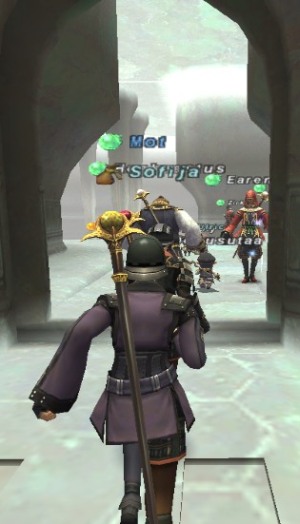
Then I have to go through the task of re-installing a lot of my programs, and Final Fantasy XI tops my list. Not being able to drop my adventuring fellows a note of my absence is difficult, not being able to check the auction house is an added inconvenience, but ultimately I just want to make sure nothing was gummed up and that the game can run fine after this fix. Sadly, the installation process could take hours and I won't even know until after I've installed the game and updated it with the latest patch. Before I can worry about all that, I need to have my computer back with a clean bill of health and I'm not even 100% on that at this point.

The wait is pure agony. Although I don't consider it a living thing, a friend, a pet or anything close, not having it evokes feelings that are reserved mostly for sick family members and loved ones. Today I feel like someone I know dearly went to the hospital and the doctors don't quite know what's wrong and I'm not quite sure if I'll get back the same person I know after all is said

Monday, February 12, 2007

Rome Picks Up

**Spoiler Warning**

I’ve wavered for a bit about Season 2 of HBO’s ROME. After taking 2006 off, the series is back airing its first episode in January. The season premiere was explosive, as expected, then it went into a kind of a lull. The main character arcs got lost somewhere in the latter half of episodes 2 and 3, with the likeable Titus Pullo /Lucius Vorenus friendship being pulled apart as Vorenus is turned into a mob boss.

I felt as if HBO was paying too much of an homage to its other mainstay franchise, the Sopranos with that story arc. Unfortunately, as of episode 5 “Heroes of the Republic” the Lucius Vorenus gangster arc remains alive, but his friendship with Titus Pullo has been repaired and the thrust of the story shifts to the political manoeuvres which took place as Octavian Caesar rises to the top of the heap and the plotting that went on when he declared Brutus an enemy of the republic.

Cicero, leader of the Senate, initially welcomed Octavian’s victory over Marc Anthony, and thought the young Octavian could be controlled by the Senate. With Octavian’s surprise motion to declare Brutus an enemy of the state, Cicero calls Brutus and his armies back to Rome.

That’s where we are at right now. Those who cared to look up the wiki page on the history of the late Republic or is a student of history will know what happens next, but the second season has entered its most dramatic phase. The factual retelling of history builds the mileposts the series must hit on a narrative scale, but what draws me to the series are the little details between the characters and their reactions to the history unfolding around them.

My only concern with Rome is how the Pullo/Vorenus arc plays out. I don’t much care of Vorenus, the conservative family man, being portrayed as the head of what is essentially a crime family, and the story has signaled way too many times that Pullo and Vorenus may eventually end up on opposite sides of coming turmoil. Going down that path may be fatal for the series.

Killing of historical characters like Julius Caesar, masterfully played by Ciaran Hinds in season one, were necessities. However, I hope the series writers don’t screw up the Pullo/Vorenus arc or Rome may yet flounder.

Monday, February 05, 2007

Hotel Dusk – Final Impressions

I blogged about the then upcoming Hotel Dusk a month ago and its release has come and gone. Although the game appears to have a limit print run, I was able to snag a copy at my local EB in late January.

Hotel Dusk Room 215, is in a word, brilliant. It is a classic noir tale spun into a masterfully designed DS game. The game isn’t perfect. Sprinkled throughout are a series of puzzles each with their own DS-specific ‘touch screen’ interface. They are quite literally mini-touch games in of themselves without hints as to how to control them. This ultimately leads to a lot of trial and error that can be frustrating.

The game’s strengths however is in its story telling and writing. Each of the more than 10 characters in the game has their own personality. The amount of text in this game is truly staggering. There are branching conversation paths, objects that can be examined and conversations with Kyle (the protagonist)’s home office which drives the story forward and keep the various disparate threads together.

Hotel Dusk takes place in the span of less than 10 hours inside on run-down hotel, and in this context, the scale of the game is quite huge. The hotel is slowly unlocked room to room and the chapter system breaks down the game narrative into hour long or half-hour long chunks. It truly is a lot like a ‘24’ style game, albeit players can spend as much time as they need on a chapter.

Although Kyle Hyde’s drive to find the partner he shot 3 years ago (Bradley) is what kicks off the story, he and the player must ultimately unravel the secrets within the Hotel Dusk to complete the game. The writers managed to weave a tale so compelling that with few exceptions, each secret unraveled leads the player (and Kyle) one step closer to solving the mystery behind Bradley and his involvement with a shady art-theft ring called Nile.

The game also features a very impressive visual style. The visuals are a mixture of watercolor studies reminiscent of architectural or industrial design and pencil on paper sketchpad animation. There’s also a fairly sturdy 3-D engine representing the entirety of the hotel environment players can explore. The 3-D environments themselves are textured in a watercolor look with the colors fading into white on the edges of a surface. The walls and floors also feature a distinctive gradient look as if painted over repeatedly by an unseen artist trying to create lighting through darker and softer tones of a hue.

The game’s graphical star however is the character animations. Oft referred to as being inspired by A-HA music video, I prefer to describe them as being animated sketchpad drawings. The ‘sketch’ look and the twitchy wavy lines lends the character life, even as the characters are standing still. Each of the characters also have a full repertoire of animated expressions, from glee, sadness, anger, denial among others which aids in characterization and makes this fairly 'old school' way of doing things superior to 3-D facial models or other more advanced techniques. The nuances that an animated character portrait allows for makes this game's characters seem authentic.

Hotel Dusk is a fantastic mystery novel in game form and it’s well worth its low price. Grab this game when you find it in stores. It probably won’t be very plentiful in used stores in the future given its apparent limited availability. If you want to know more about this game, check out its official website.

Thursday, January 11, 2007

Twilight Princess - A Visual Game


40 hours in, The Legend of Zelda: Twilight Princess is just as good as I had imagined. It is rare in this day and age for hyped products (and Zelda certainly is hyped at least among gamers) to live up to expectations. The game isn’t perfect, and I had wished Miyamoto had listened to his team members for creating a Twilight Princess SP version for Wii owners, but that's really a minor quibble and gives me something to look forward to in their next Wii-specific Zelda title.

The challenge is there, and obviously this game is not ‘hardcore’ hard, it’s accessible enough for any able men and women (also children, never forget them) who are willing to tackle this gargantuan quest. My early worries about the ‘standard’ right-handed Wii-mote controls being impossible for me as a lefty has been disproved. But then again I’m a life long right-handed mouse user and found pointing the Wiimote right handed to be very natural and intuitive.

But what I want to talk about today is the look of the game. Visually, everything I had hoped in my wildest dreams as a teenager 10 years ago writing for Nintendojo with Michael Veroni has been put into the game. In 1997, before The Ocarina of Time was released, my only frame of reference for how a it would feel to play a 3-D Zelda game was to look at some of the production paintings for A Link to the Past and the official art found in the Nintendo Power Player’s Guides.


Several images have always stuck with me. There was the picture of Link standing on top of Death Mountain looking down at Hyrule below, and perhaps the most striking image is that of a the Master Sword resting on its pedestal deep in the a verdant forest sanctuary, with beans of sunlight filtering through the forest canopy. Then there were the images from the official player’s guides that were not only artistically beautiful but embodied the look and feel of a true 3-D Zelda game. The scale of the images were epic and cinematic. I remember the picture of Link climbing on top of a rock outcrop only to discover the entrance to the a temple ruin and another one of Link hiding behind a half broken pillar, bow ready, while Ganon in his beast form stalks him.

In 3-D however, I was never quite pleased with Ocarina of Time’s handling of many of Zelda’s elements. The famous Lost Woods was turned into a series of boxed rooms with forest wall textures, and the Master Sword was found in the temple of time instead. In fact, while Ocarina of Time was visually great in 1998, many of the epic images I had of what a Zelda game should look like in 3-D were never realized. In Wind Waker (2003), the toonshaded look and limited selection of dungeons as well as the game's context (sailing between islands) failed to tap the GameCube's power to project the epic images of the artwork that have always stuck with me.

Thankfully it is in Twilight Princess that series producer Shigeru Miyamoto and director Eiji Aonuma finally put many of the elements into place. The Master Sword can now be found in its home inside the great forests of Hyrule. The landscapes of Hyrule have finally come alive, bloom lighting and all.

Thursday, January 04, 2007

Hotel Dusk


If you were to ask a hardcore gamer why they think the Nintendo DS is such a huge hit in Japan and is increasingly pulling away from its rival in the West, they will probably point to the new Mario game, lots of software for big name third parties (specially Square-Enix), and non-games, a new genre of games loosely connected as games that appeal to people who don’t normally play games which has expanded the market and allowed Nintendo to tap into entire demographics (older gamers, girls and women).

The other side of the story however is a growing library of demographic specific titles such as the upcoming Hotel Dusk: Room 215 (known as Wish Room in Japan) which brings back the point and click style ‘adventure’ games that were all the rage on the PCs in the early to mid 90s.

The move over to massively multiplayer and first person games on the PC have driven out the franchise, and adventure games have never found a home on consoles, which in the 90s, at least in the west, was dominated largely by twitch platformers and combat games.

Hotel Dusk is a mystery adventure story set in America during the late 70s and is developed by a small Japanese development house called CING for Nintendo. It features an eye catchy art style with game’s cast of characters portrayed in a pencil on paper 'flip book' animation style. The exploring in contrast is done inside richly textured interactive 3-D environments. This game is full of atmosphere. I love the setting, it has that 80s-style Hollywood noir movie feel to it.

As an aside, CING also developed the relatively short adventure, Trace Memory for Nintendo as part of the DS launch library. The game was criticized at the time for being too simple and short and may have been targeted to a younger audience. As the DS audience has grown however, and Nintendo found many older gamers have picked up a DS, Hotel Dusk appears to be more compatible with my tastes.

Catch the Japanese trailer here. If you have a good eye, you can also catch a glimpse of the De Niro look-alike.


Monday, December 11, 2006

OFFICIAL: Dragon Quest IX for the Nintendo DS

At the Dragon Quest 20th anniversary event, Dragon Quest IX, the latest installment to the hugely popular RPG series in Japan has been announced to be a Nintendo DS title!
This marks Dragon Quest's return to a Nintendo console in 10 years and the first since Dragon Quest VI

The game is developed by Level 5 (the same team who worked on DQ VIII for the PS2) and will be in 3-D.


Update: The game is slated to be launched in the middle of 2007.
Update2: Subtitle is Defender of the Stars. It will apparently support up to 4 players.


read more | digg story

SONY: Oops! We did it Again.

Sony’s PSP marketing has gone off the deep end

The once well oiled marketing machine that sold the RPG to Americans with glossy ads have been reduced to bungling the advertising campaign of the PSP not once, twice, thrice, but FOUR times (at least).


There were the ill-conceived ‘fake’ PSP graffiti ads, the ‘White is Coming’ European PSP ads which featured a white woman grasping the face of a black man that were accused of having racist undertones. Then last year’s awful ‘Portable Nuts’campaign failed to ignite public interest in the machine in the territory where the PSP had performed the strongest, North America. The spots featured animated squirrels talking like gangsters and trying to sell consumers the idea of the PSP as being a portable equivalents of what gamers have in their home since the PSP is supposedly very close to the PS2 architecturally.

Like to eat nuts at home? Well with a PSP, you can take your nuts on the road, ‘portable nuts’ get it?

Well, this really takes the cake. Sony’s viral markets tried to cash in on the youtube craze by signing up and uploading various supposedly ‘fan made’ videos ‘normal’ people rapping or singing to concept of ‘wanting a PSP’ for Christmas. One of the most awful videos featured an Eminem wannabe who sings a very bad rap about wanting a PSP. As the original poster at Something Awful noted:


A few things stood out, though: he apparently bought a PSP faceplate just for dancing with in this video, he praises random features of the PSP (I love the big screen?), just small shit like that.


This caught the attention of a few people. The video leads YouTubites to a website, which proved to be the viral marketer’s undoing. A BBC blog later noted what happened next.

The video/blog/ads featured people portending to be authentic PSP fans creating messages of love/want for the console, but were quickly uncovered by SomethingAwful.com's dedicated base as superficial facades shielding mouthpieces for the corporation.


So there you have it. Another awful Christmas for Sony and its PSP, and I was actually beginning to like its PSP marketing, you know, the classy ones featuring the emo girlfriend leading her boyfriend on a wild PSP/1 Gig memory stick scavenger hunt through the hip part of town ending with the two meeting. Those were nicely done, but it seems like these YouTube ads were the Internet component of that campaign.


read more | digg story

Sunday, December 10, 2006

The November NPD


The November NPD results was released last Thursday but I didn’t get a chance to make a post about it. Here are the numbers (US sales data only) gathered from official published sources.

  1. Nintendo DS - 918K
  2. PlayStation 2 - 664K
  3. Game Boy Advance - 641K
  4. Xbox 360 - 511K
  5. Nintendo Wii - 476K
  6. PSP - 412k
  7. PlayStation 3 - 197K

The Wii and PS3 Numbers were not big surprises as Nintendo has already noted it had shipped 600,000 Wii units to North America in November, and Electronic Arts mentioned that Sony managed to only sell/ship 200,000 PS3s in the same time frame.

The real star of the month was the Nintendo DS. This was a portable that many expected would have been demolished by the technologically superior PSP and for a time it looked like it was going to happen. In stark contrast to 2006, 2005 was when the DS and the PSP were engaged in a neck and neck race with the PSP outselling the DS most months by a hair (5k-20k units), although by that time, the DS was already outselling the PSP handily and Japan.


I can’t stress this enough, the Nintendo DS is a monster of a gaming machine. It’s transcended the ghettos of portables (think of GameBoy and most hardcore games think of the handful of AAA Nintendo franchise titles amidst a sea of 3rd party shovelware.). Although western developers may still adhere to this view and thus put out titles accordingly, the quality and quantity of titles coming from Japanese 3rd parties are absolutely amazing. Square-Enix’s big titles not withstanding, there’s a wealth of games ranging from RPGs, simulations, to classic point and click adventures. Even EA has a Sim City DS in the works (so far announced for Japan only).

I honestly can’t say I’ve enjoyed a gaming platform as thoroughly as I have with my DS since the days of the Super NES. I can jump for the brain teasers of a Brain Training game to the depths of a fantastical world of Final Fantasy in a matter of minutes and Animal Crossing: Wild World has become a kind of companion to me. I boot it up most nights for 20-30 minutes, to water my plants, pick my orchard and manage my virtual town. I go on-line occasionally to receive mail from the developers. This modest feature further enhances the connection the game has with the rest of the Nintendo universe – for example when the Wii launched, Nintendo sent out virtual mail packages to Animal Crossing residents announcing the launch of Zelda and Wii sports and containing either the Master Sword or Bowling pins (Wii sports), I got the bowling pins.

So there you have it. DS won November, but if you want to tally it by manufacturer, it is worth nothing that Nintendo romped everyone. DS + GBA + Wii sold over 2 million hardware units of the overall 3.8 million hardware units sold in the month. Oh and the GameCube sold 70k units if you’re still keeping track.

Monday, December 04, 2006

Wii Sells out in Japan, Luigi is Arrested


The Wii was launched in Japan on Dec 02, Saturday this past weekend and all 400,000 launch units sold out within the day according to Nikkei news service. For those following the Wii story, the sell out was unexpected.*

Although Nintendo hardware launches have always been met with a sell-out, the launch quantities and the lucklustre performance of the GameCube had left many speculating that once the die hard fans get their units, there would be plenty left over for walk-in buyers.

As this theory was proven false in the North American launch, it appears to be wrong in Japan as well. The big news aside from the launch day sell-out is that this is apparently Nintendo’s biggest home console launch ever, in terms of pure quantity of units shipped making it the next-gen market leader in Japan the day it was launched.

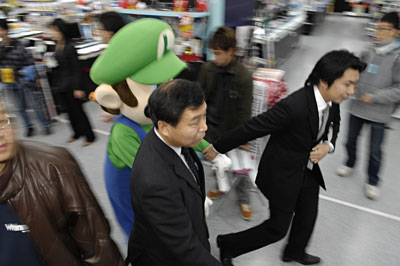
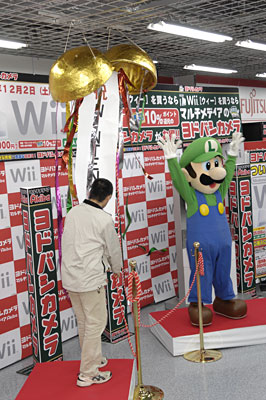
In a bit of a funny aside, a cosplayer (costume player) was mistaken to have been sent by Nintendo to participate in the launch celebrations and was asked to help a Tokyo games store mark the midnight launch of the Wii console. The in-store celebratory events (complete with confetti and a countdown to midnight) is not uncommon in hardware launches (there was a similar event for the PS3 launch).

Store employees soon discovered the Luigi mascot was in fact not a Nintendo representative but a regular guy in a Luigi costume and he was promptly arrested. His arrest has turned into a cult event celebrated among the Japanese netizens, which included a pictorial story of the sequence of events leading to the arrest and a photoshop showing the cosplayer behind the mask was none other than PlayStation creator Ken Kutaragi.

Funny stuff.

*Media Create, the weekly sales tracking service has tracked 350,000 Wii sold between Saturday and Sunday. This is 50,0000 units below Nintendo's stated shipment figures of 400,000 units. That said, Media Create's numbers are the 'quick and dirty' big picture look at weekly sales and are not 100% accurate due to the speed in which the data is produced (3 days after the Sunday end of the week cut off for its tracking).


Above: Luigi cosplayer moments before his arrest.

Sunday, November 26, 2006

Where are the Wiis?


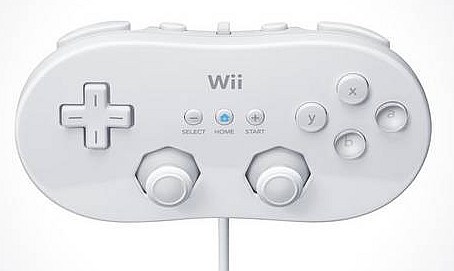
Well I’m not going to go rant for 3 paragraphs about how I didn’t or couldn’t get a Wii last Sunday and haven’t been able to obtain on since despite a restock on Friday, but I don’t have a Wii, but I have a classic controller sitting next to me (for the Virtual console stuff) and the controller gives me a strange sense of what a Super Nintendo controller might have looked like had it existed in an alternate dimension where it was a 3-D late generation console. It's really comfortable to hold and I have a feeling I am going to really enjoy using this controller for playing all the Virtual Console games, over the Wii remote and GameCube controller.

Speaking of which the Wii is not only selling like mad (ie: sold out) its accessories are as well. I went to Futureshop yesterday and saw a bunch of Wii nunchuck, Wii remote and Wii classic controllers. When I went back today, they were all gone.

From the beating heart of the gaming forums on the interweb, NeoGAF (aka GAF or Gaming-Age Forums), reactions have been positive with threads like this one. What Wii has achieved it seems is to turn console launches into social events and a shared cultural experience.

The real question of course is how many units did Microsoft, Nintendo and Sony push in the past week and leading up the end of the month. Sales predictions is a bloodless sport and is most popular on NeoGAF, the aforementioned metropolis of cool ‘insider’ gaming forums.

Filter through the various defense forces, trolls, kids and viral marketers and you’ll find real gold in the sales threads with very insightful analysis of where each of the big 3 companies are going in terms of their product sales, positioning and future prospects. With the dual launch of the Wii and the PlayStation 3, this November’s NPD (NPD is a sales tracking service) is expected to be a big hit among the NeoGaffers, such is the anticipation for the numbers that someone even made a pretty cool trailer. And as a forum regular and lurker, I must agree with the sentiment. This Novemeber’s NPD may be the biggest event of the season (aside from the actual hardware launches) for those games who care about sales.


Monday, November 13, 2006

Twilight Fantasy

The full trailer to Twilight Princess which I alluded to in my previous post is now posted The only reason I did not include the trailer in my previous post was I could not find a decent enough feed from YouTube to link to. So I’ve decided to upload my own copy of the trailer (courtesy of GameTrailers) and put it up on YouTube. The Zelda franchise has certainly come a long way since Ocarina of Time, and Twilight Princess appears to be the most expressive and cinematic of all the games.*


*Disclaimer. Wind Waker featured a version of Link that for its time was the most expressive ever put into a Zelda game and still holds the record today. However, the cartoon like art style put many people off. This Link not only retains the same level of expressiveness (facial expressions, eye movements, and fluidity of motion) the graphical style is what people wanted for a 3-D next-gen follow up to Ocarina..

Moving off the gaming track, I went to see Borat today. It’s a great movie as a pure situational comedy. But on a more cerebral level, the movie also plays on and pokes fun of cultural norms in the United States and the western/modern world in general. (Borat having trouble going to restroom is one such situation.). I think more importantly, it also sheds light that ‘the other’ (as in the rest of the world) can be as racist and ignorant the rest of the mainstream in the rich industrialized world who are constantly hammered by the notions of their guilt as members of an elite ruling class (the winners). The economic and social ‘losers’ are always painted in the same brush strokes as good people in needed help, which is, as Borat portrays, a bit simplistic. It’s a very black and white way to look at the world and to tackle the complexities of ethnic hatreds and racial politics. But it persists as the de-facto standard in while race relations is dealt with in many rich countries

It is therefore instructive to say that liberalism in the west is mostly pre-occupied with self blame and correcting historical wrongs. But as the movie shows us, the quest to be politically correctness maybe an unwinnable war. That is, the sworn enemy is among us, is amorphous, and it is us. The movie’s sympathetic hero, Borat, is a racist, sexist anti-Semite, but we’re made to feel sympathy for him because he's genuinely human. Most bigots are human too and are not one dimensional. Which begs the question of which side Borat is on. These kinds of prejudices run rampant in the old world and in almost all countries. In one of the movie’s deeper scenes, he talks to a group of college frat boys who (probably not acting) remarks that the ‘minorities in this country [the USA] have more power than the mainstream.’

It’s arguable of course whether this is true. After all, the young man was saying this as he is being driven in a RV as a University student, a privilege not many enjoy. But the perception is there among the general public, and it is powering or has powered a tide of conservative backlash that has placed ideologues in the White House, ruined the good name of America and at one point until last week, controlled the United States Congress.

A Canadian who wrote a book about the United States once argued that the US as a country prides its individuality and freedom above all other virtues, and as such it is a land of extremes. Much of what goes on there is the formation and reaction of extremes. There are the avant-garde social movements like gay pride, environmental activism, civil rights, and affirmative action in the cities. In reaction to these movements, those people outside to the city grow closer to their church and become more conservative. I think Borat as a movie shows us that extreme. He travels from Liberal ‘godless’ New York City where people run away from his warmth to the deep south where he is welcomed with open arms. These two scenes represent the extremes of a country. In many ways, the country Borat travels is the real star of the movie, not the comedian.

Sunday, November 12, 2006

The Legend of Zelda

Over the past week, I have re-watched two amazing pieces of PR video Nintendo released to promote its game. The first video is the game’s introduction, set to a brilliant choral re-imagination of The Legend of Zelda (NES) opening theme with visual allusions to the Ocarina of Time, including a reversed but similar camera movement where the camera speeds along the field of Hyrule as it slowly pans up to reveal the horizon.

Comparisons are already being made between Twilight Princess and Ocarina of Time. Suffice to say that I note the differences between the two games.
Materially the differences are obvious to me, even if most people on-line are still assuming the game itself will surpass Ocarina by default (which is a bit premature). I think that Twilight Princess, in its original incarnation as a GameCube exclusive was doomed to disappoint a lot of people by simply being too similar to Ocarina of Time. The cynics and the jaded gamers among us who are waiting at the slightest thing to bring down the sacred cow would probably have latched on to this lack of originality as their key complaint.
And this isn’t Nintendo or Miyamoto’s fault per se. Ocarina of Time transferred Zelda from 2-D to 3-D flawlessly. Another 3-D Zelda in the same general aesthetic direction as Ocarina cannot be but a refinement of the original formula. That is of course until Nintendo decide to make Twilight Princess into the premiere launch title of it Wii console with a new control scheme.
I’m genuinely excited about the Twilight Princess both as a new entry to the Zelda adventure, a refinement of the visuals and gameplay I enjoyed since Ocarina of Time. and as a completely new way to experience the Zelda games. I’m a left handed player so I am somewhat concerned that the mirrored world of Twilight Princess might be a problem. I’ll find out soon enough.

Sunday, August 13, 2006

Temenos Liberator


The culmination of about a month and a half of work, and nearly five months of working together as a group was the fight against one of the harder ‘boss’ characters of the game, the Proto-Ultima Weapon.

Players who unlocked their access to Al Tieu will have fought a tough battle against Ultima and Omega back to back on the airship, but this Ultima is about five times harder and requires many more people (at level 75) to kill than the small party of six capped at level 60 for the airship version of Ultima.

The Proto-Ultima fight was also a bit of a ‘scary’ thing. All of us having fought it on the airship to gain ‘access’ to the new areas knew how tough it was back then and knew we had a challenge in our hands. As we spend the weeks collecting the chips to fight him on Temenos Central’s 4th floor, we were constantly reminded of how powerful it is. Proto-Ultima has a series of moves that can do massive damage to everyone in range, including a devastating ‘Citadel Buster’ move that will kill whoever he has enmity on as well as anyone else nearby. To survive everyone must exit the room as Ultima counted down, and the person with enmity is killed. With everyone safely out of range, the damage of limited to a few deaths rather than the entire group dying.

We designated today as our 1st Proto-Ultima ‘run’. No one, including myself expected to succeed, as failure is not uncommon and we may yet fail. However, today was not going to be a day of failures. Ater a tough hour-long battle and many deaths, Proto-Ultima was vanquished and we all earned the title of Temenos Liberator. Three lucky members also got parts of the vanquished Ultima, a pre-requisite for obtaining the mage oriented Nashira set of armor.

Sunday, August 06, 2006

E3 is Dead


It’s official. E3 as we knew it is dead. Last Monday the Entertainment Software Association announced that the giant industry trade show held every May, preceded by multimillion dollar press conferences from the big 3 manufacturers, and best known to the general public as that ‘videogame thing’ in Los Angeles, has been cancelled.

Ultimately it came down to a cost vs. benefit equation. According to Next-Generation, many publishers simply did not see the benefit of spending millions of dollars in a trade show to compete with other major publishers spending an equally massive amount when they would make their own events get all the attention. “Once Nintendo, Microsoft, SCEA and EA had stepped out, E3 was history. It was multilateral disarmament,” explained Next-Generation.biz’s Colin Campbell.

The Fans Loses

While Japan celebrates a hobbyist culture, with conventions held in and around Tokyo for hobbies of every stripe, North Americans have relegated hobbyist conventions to the realm of the nerds and Trekkies. The massive financial and PR success of Lucasfilm’s ‘Star Wars Celebration’ conventions have done little to change this attitude. Even as the Tokyo Game show is said to be under threat of cancellation, its genesis is rumoured to be an even more massive show combining Anime, and other subcultures into one massive hobbyist convention.

Contrasting E3’s death is the upcoming Leipzig Games Convention. Instead of a hand-me down trade show where the big three rehash their E3 announcement for the European public, Nintendo promises 5 new Nintendo Wii (pronounced We) games will be shown. Some Europeans have even gone as far as proclaiming that E3’s death is good for Europe.

But such conclusions may be a little early. North America is the world’s largest consumer of videogames dwarfing both Japan and Europe, albeit per capita, the Japanese are still the bigger consumers. The decisions and big announcements will still be made on this continent. But without a centralized trade-show and having no consumer based hobbyist show for the fans, the Europeans have a right to brag about their games convention, which is expected to draw over 150,000 attendees from the public compared to E3’s 60,000 trade attendees at its height.

In previous years, dedicated fans of the hobby got around the trade-only moniker of E3 by moving their way into the industry working retail or becoming ‘internet journalists’. In its demise there’s nothing quite as big to replace it. Sony, Microsoft and Nintendo will doubtless have lax policies for their fans, bloggers and net journalists to enter their own events and the new downsized E3, expected to hold 6,000 from the industry. But gamers who want something more centralized will no longer be afforded this opportunity.

When will North Americans get a public games convention of our own?