Thursday, January 11, 2007

Twilight Princess - A Visual Game


40 hours in, The Legend of Zelda: Twilight Princess is just as good as I had imagined. It is rare in this day and age for hyped products (and Zelda certainly is hyped at least among gamers) to live up to expectations. The game isn’t perfect, and I had wished Miyamoto had listened to his team members for creating a Twilight Princess SP version for Wii owners, but that's really a minor quibble and gives me something to look forward to in their next Wii-specific Zelda title.

The challenge is there, and obviously this game is not ‘hardcore’ hard, it’s accessible enough for any able men and women (also children, never forget them) who are willing to tackle this gargantuan quest. My early worries about the ‘standard’ right-handed Wii-mote controls being impossible for me as a lefty has been disproved. But then again I’m a life long right-handed mouse user and found pointing the Wiimote right handed to be very natural and intuitive.

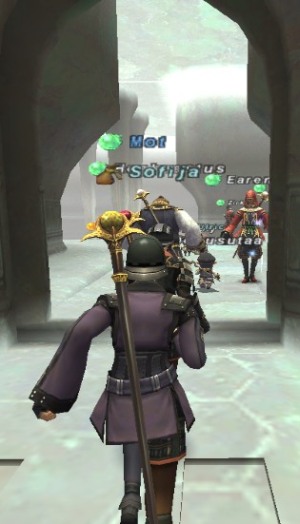
But what I want to talk about today is the look of the game. Visually, everything I had hoped in my wildest dreams as a teenager 10 years ago writing for Nintendojo with Michael Veroni has been put into the game. In 1997, before The Ocarina of Time was released, my only frame of reference for how a it would feel to play a 3-D Zelda game was to look at some of the production paintings for A Link to the Past and the official art found in the Nintendo Power Player’s Guides.


Several images have always stuck with me. There was the picture of Link standing on top of Death Mountain looking down at Hyrule below, and perhaps the most striking image is that of a the Master Sword resting on its pedestal deep in the a verdant forest sanctuary, with beans of sunlight filtering through the forest canopy. Then there were the images from the official player’s guides that were not only artistically beautiful but embodied the look and feel of a true 3-D Zelda game. The scale of the images were epic and cinematic. I remember the picture of Link climbing on top of a rock outcrop only to discover the entrance to the a temple ruin and another one of Link hiding behind a half broken pillar, bow ready, while Ganon in his beast form stalks him.

In 3-D however, I was never quite pleased with Ocarina of Time’s handling of many of Zelda’s elements. The famous Lost Woods was turned into a series of boxed rooms with forest wall textures, and the Master Sword was found in the temple of time instead. In fact, while Ocarina of Time was visually great in 1998, many of the epic images I had of what a Zelda game should look like in 3-D were never realized. In Wind Waker (2003), the toonshaded look and limited selection of dungeons as well as the game's context (sailing between islands) failed to tap the GameCube's power to project the epic images of the artwork that have always stuck with me.

Thankfully it is in Twilight Princess that series producer Shigeru Miyamoto and director Eiji Aonuma finally put many of the elements into place. The Master Sword can now be found in its home inside the great forests of Hyrule. The landscapes of Hyrule have finally come alive, bloom lighting and all.

Thursday, January 04, 2007

Hotel Dusk


If you were to ask a hardcore gamer why they think the Nintendo DS is such a huge hit in Japan and is increasingly pulling away from its rival in the West, they will probably point to the new Mario game, lots of software for big name third parties (specially Square-Enix), and non-games, a new genre of games loosely connected as games that appeal to people who don’t normally play games which has expanded the market and allowed Nintendo to tap into entire demographics (older gamers, girls and women).

The other side of the story however is a growing library of demographic specific titles such as the upcoming Hotel Dusk: Room 215 (known as Wish Room in Japan) which brings back the point and click style ‘adventure’ games that were all the rage on the PCs in the early to mid 90s.

The move over to massively multiplayer and first person games on the PC have driven out the franchise, and adventure games have never found a home on consoles, which in the 90s, at least in the west, was dominated largely by twitch platformers and combat games.

Hotel Dusk is a mystery adventure story set in America during the late 70s and is developed by a small Japanese development house called CING for Nintendo. It features an eye catchy art style with game’s cast of characters portrayed in a pencil on paper 'flip book' animation style. The exploring in contrast is done inside richly textured interactive 3-D environments. This game is full of atmosphere. I love the setting, it has that 80s-style Hollywood noir movie feel to it.

As an aside, CING also developed the relatively short adventure, Trace Memory for Nintendo as part of the DS launch library. The game was criticized at the time for being too simple and short and may have been targeted to a younger audience. As the DS audience has grown however, and Nintendo found many older gamers have picked up a DS, Hotel Dusk appears to be more compatible with my tastes.

Catch the Japanese trailer here. If you have a good eye, you can also catch a glimpse of the De Niro look-alike.


Monday, December 11, 2006

OFFICIAL: Dragon Quest IX for the Nintendo DS

At the Dragon Quest 20th anniversary event, Dragon Quest IX, the latest installment to the hugely popular RPG series in Japan has been announced to be a Nintendo DS title!
This marks Dragon Quest's return to a Nintendo console in 10 years and the first since Dragon Quest VI

The game is developed by Level 5 (the same team who worked on DQ VIII for the PS2) and will be in 3-D.


Update: The game is slated to be launched in the middle of 2007.
Update2: Subtitle is Defender of the Stars. It will apparently support up to 4 players.


read more | digg story

SONY: Oops! We did it Again.

Sony’s PSP marketing has gone off the deep end

The once well oiled marketing machine that sold the RPG to Americans with glossy ads have been reduced to bungling the advertising campaign of the PSP not once, twice, thrice, but FOUR times (at least).


There were the ill-conceived ‘fake’ PSP graffiti ads, the ‘White is Coming’ European PSP ads which featured a white woman grasping the face of a black man that were accused of having racist undertones. Then last year’s awful ‘Portable Nuts’campaign failed to ignite public interest in the machine in the territory where the PSP had performed the strongest, North America. The spots featured animated squirrels talking like gangsters and trying to sell consumers the idea of the PSP as being a portable equivalents of what gamers have in their home since the PSP is supposedly very close to the PS2 architecturally.

Like to eat nuts at home? Well with a PSP, you can take your nuts on the road, ‘portable nuts’ get it?

Well, this really takes the cake. Sony’s viral markets tried to cash in on the youtube craze by signing up and uploading various supposedly ‘fan made’ videos ‘normal’ people rapping or singing to concept of ‘wanting a PSP’ for Christmas. One of the most awful videos featured an Eminem wannabe who sings a very bad rap about wanting a PSP. As the original poster at Something Awful noted:


A few things stood out, though: he apparently bought a PSP faceplate just for dancing with in this video, he praises random features of the PSP (I love the big screen?), just small shit like that.


This caught the attention of a few people. The video leads YouTubites to a website, which proved to be the viral marketer’s undoing. A BBC blog later noted what happened next.

The video/blog/ads featured people portending to be authentic PSP fans creating messages of love/want for the console, but were quickly uncovered by SomethingAwful.com's dedicated base as superficial facades shielding mouthpieces for the corporation.


So there you have it. Another awful Christmas for Sony and its PSP, and I was actually beginning to like its PSP marketing, you know, the classy ones featuring the emo girlfriend leading her boyfriend on a wild PSP/1 Gig memory stick scavenger hunt through the hip part of town ending with the two meeting. Those were nicely done, but it seems like these YouTube ads were the Internet component of that campaign.


read more | digg story

Sunday, December 10, 2006

The November NPD


The November NPD results was released last Thursday but I didn’t get a chance to make a post about it. Here are the numbers (US sales data only) gathered from official published sources.

  1. Nintendo DS - 918K
  2. PlayStation 2 - 664K
  3. Game Boy Advance - 641K
  4. Xbox 360 - 511K
  5. Nintendo Wii - 476K
  6. PSP - 412k
  7. PlayStation 3 - 197K

The Wii and PS3 Numbers were not big surprises as Nintendo has already noted it had shipped 600,000 Wii units to North America in November, and Electronic Arts mentioned that Sony managed to only sell/ship 200,000 PS3s in the same time frame.

The real star of the month was the Nintendo DS. This was a portable that many expected would have been demolished by the technologically superior PSP and for a time it looked like it was going to happen. In stark contrast to 2006, 2005 was when the DS and the PSP were engaged in a neck and neck race with the PSP outselling the DS most months by a hair (5k-20k units), although by that time, the DS was already outselling the PSP handily and Japan.


I can’t stress this enough, the Nintendo DS is a monster of a gaming machine. It’s transcended the ghettos of portables (think of GameBoy and most hardcore games think of the handful of AAA Nintendo franchise titles amidst a sea of 3rd party shovelware.). Although western developers may still adhere to this view and thus put out titles accordingly, the quality and quantity of titles coming from Japanese 3rd parties are absolutely amazing. Square-Enix’s big titles not withstanding, there’s a wealth of games ranging from RPGs, simulations, to classic point and click adventures. Even EA has a Sim City DS in the works (so far announced for Japan only).

I honestly can’t say I’ve enjoyed a gaming platform as thoroughly as I have with my DS since the days of the Super NES. I can jump for the brain teasers of a Brain Training game to the depths of a fantastical world of Final Fantasy in a matter of minutes and Animal Crossing: Wild World has become a kind of companion to me. I boot it up most nights for 20-30 minutes, to water my plants, pick my orchard and manage my virtual town. I go on-line occasionally to receive mail from the developers. This modest feature further enhances the connection the game has with the rest of the Nintendo universe – for example when the Wii launched, Nintendo sent out virtual mail packages to Animal Crossing residents announcing the launch of Zelda and Wii sports and containing either the Master Sword or Bowling pins (Wii sports), I got the bowling pins.

So there you have it. DS won November, but if you want to tally it by manufacturer, it is worth nothing that Nintendo romped everyone. DS + GBA + Wii sold over 2 million hardware units of the overall 3.8 million hardware units sold in the month. Oh and the GameCube sold 70k units if you’re still keeping track.

Monday, December 04, 2006

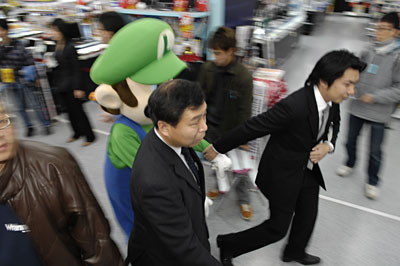
Wii Sells out in Japan, Luigi is Arrested


The Wii was launched in Japan on Dec 02, Saturday this past weekend and all 400,000 launch units sold out within the day according to Nikkei news service. For those following the Wii story, the sell out was unexpected.*

Although Nintendo hardware launches have always been met with a sell-out, the launch quantities and the lucklustre performance of the GameCube had left many speculating that once the die hard fans get their units, there would be plenty left over for walk-in buyers.

As this theory was proven false in the North American launch, it appears to be wrong in Japan as well. The big news aside from the launch day sell-out is that this is apparently Nintendo’s biggest home console launch ever, in terms of pure quantity of units shipped making it the next-gen market leader in Japan the day it was launched.

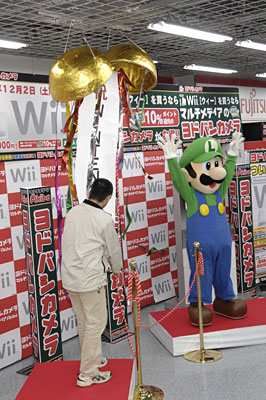
In a bit of a funny aside, a cosplayer (costume player) was mistaken to have been sent by Nintendo to participate in the launch celebrations and was asked to help a Tokyo games store mark the midnight launch of the Wii console. The in-store celebratory events (complete with confetti and a countdown to midnight) is not uncommon in hardware launches (there was a similar event for the PS3 launch).

Store employees soon discovered the Luigi mascot was in fact not a Nintendo representative but a regular guy in a Luigi costume and he was promptly arrested. His arrest has turned into a cult event celebrated among the Japanese netizens, which included a pictorial story of the sequence of events leading to the arrest and a photoshop showing the cosplayer behind the mask was none other than PlayStation creator Ken Kutaragi.

Funny stuff.

*Media Create, the weekly sales tracking service has tracked 350,000 Wii sold between Saturday and Sunday. This is 50,0000 units below Nintendo's stated shipment figures of 400,000 units. That said, Media Create's numbers are the 'quick and dirty' big picture look at weekly sales and are not 100% accurate due to the speed in which the data is produced (3 days after the Sunday end of the week cut off for its tracking).


Above: Luigi cosplayer moments before his arrest.

Sunday, November 26, 2006

Where are the Wiis?


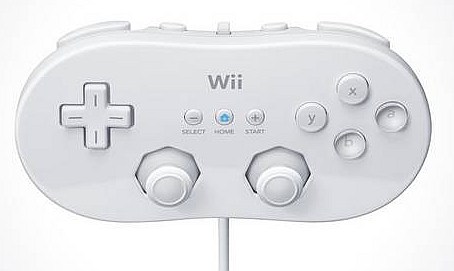
Well I’m not going to go rant for 3 paragraphs about how I didn’t or couldn’t get a Wii last Sunday and haven’t been able to obtain on since despite a restock on Friday, but I don’t have a Wii, but I have a classic controller sitting next to me (for the Virtual console stuff) and the controller gives me a strange sense of what a Super Nintendo controller might have looked like had it existed in an alternate dimension where it was a 3-D late generation console. It's really comfortable to hold and I have a feeling I am going to really enjoy using this controller for playing all the Virtual Console games, over the Wii remote and GameCube controller.

Speaking of which the Wii is not only selling like mad (ie: sold out) its accessories are as well. I went to Futureshop yesterday and saw a bunch of Wii nunchuck, Wii remote and Wii classic controllers. When I went back today, they were all gone.

From the beating heart of the gaming forums on the interweb, NeoGAF (aka GAF or Gaming-Age Forums), reactions have been positive with threads like this one. What Wii has achieved it seems is to turn console launches into social events and a shared cultural experience.

The real question of course is how many units did Microsoft, Nintendo and Sony push in the past week and leading up the end of the month. Sales predictions is a bloodless sport and is most popular on NeoGAF, the aforementioned metropolis of cool ‘insider’ gaming forums.

Filter through the various defense forces, trolls, kids and viral marketers and you’ll find real gold in the sales threads with very insightful analysis of where each of the big 3 companies are going in terms of their product sales, positioning and future prospects. With the dual launch of the Wii and the PlayStation 3, this November’s NPD (NPD is a sales tracking service) is expected to be a big hit among the NeoGaffers, such is the anticipation for the numbers that someone even made a pretty cool trailer. And as a forum regular and lurker, I must agree with the sentiment. This Novemeber’s NPD may be the biggest event of the season (aside from the actual hardware launches) for those games who care about sales.


Monday, November 13, 2006

Twilight Fantasy

The full trailer to Twilight Princess which I alluded to in my previous post is now posted The only reason I did not include the trailer in my previous post was I could not find a decent enough feed from YouTube to link to. So I’ve decided to upload my own copy of the trailer (courtesy of GameTrailers) and put it up on YouTube. The Zelda franchise has certainly come a long way since Ocarina of Time, and Twilight Princess appears to be the most expressive and cinematic of all the games.*


*Disclaimer. Wind Waker featured a version of Link that for its time was the most expressive ever put into a Zelda game and still holds the record today. However, the cartoon like art style put many people off. This Link not only retains the same level of expressiveness (facial expressions, eye movements, and fluidity of motion) the graphical style is what people wanted for a 3-D next-gen follow up to Ocarina..

Moving off the gaming track, I went to see Borat today. It’s a great movie as a pure situational comedy. But on a more cerebral level, the movie also plays on and pokes fun of cultural norms in the United States and the western/modern world in general. (Borat having trouble going to restroom is one such situation.). I think more importantly, it also sheds light that ‘the other’ (as in the rest of the world) can be as racist and ignorant the rest of the mainstream in the rich industrialized world who are constantly hammered by the notions of their guilt as members of an elite ruling class (the winners). The economic and social ‘losers’ are always painted in the same brush strokes as good people in needed help, which is, as Borat portrays, a bit simplistic. It’s a very black and white way to look at the world and to tackle the complexities of ethnic hatreds and racial politics. But it persists as the de-facto standard in while race relations is dealt with in many rich countries

It is therefore instructive to say that liberalism in the west is mostly pre-occupied with self blame and correcting historical wrongs. But as the movie shows us, the quest to be politically correctness maybe an unwinnable war. That is, the sworn enemy is among us, is amorphous, and it is us. The movie’s sympathetic hero, Borat, is a racist, sexist anti-Semite, but we’re made to feel sympathy for him because he's genuinely human. Most bigots are human too and are not one dimensional. Which begs the question of which side Borat is on. These kinds of prejudices run rampant in the old world and in almost all countries. In one of the movie’s deeper scenes, he talks to a group of college frat boys who (probably not acting) remarks that the ‘minorities in this country [the USA] have more power than the mainstream.’

It’s arguable of course whether this is true. After all, the young man was saying this as he is being driven in a RV as a University student, a privilege not many enjoy. But the perception is there among the general public, and it is powering or has powered a tide of conservative backlash that has placed ideologues in the White House, ruined the good name of America and at one point until last week, controlled the United States Congress.

A Canadian who wrote a book about the United States once argued that the US as a country prides its individuality and freedom above all other virtues, and as such it is a land of extremes. Much of what goes on there is the formation and reaction of extremes. There are the avant-garde social movements like gay pride, environmental activism, civil rights, and affirmative action in the cities. In reaction to these movements, those people outside to the city grow closer to their church and become more conservative. I think Borat as a movie shows us that extreme. He travels from Liberal ‘godless’ New York City where people run away from his warmth to the deep south where he is welcomed with open arms. These two scenes represent the extremes of a country. In many ways, the country Borat travels is the real star of the movie, not the comedian.

Sunday, November 12, 2006

The Legend of Zelda

Over the past week, I have re-watched two amazing pieces of PR video Nintendo released to promote its game. The first video is the game’s introduction, set to a brilliant choral re-imagination of The Legend of Zelda (NES) opening theme with visual allusions to the Ocarina of Time, including a reversed but similar camera movement where the camera speeds along the field of Hyrule as it slowly pans up to reveal the horizon.

Comparisons are already being made between Twilight Princess and Ocarina of Time. Suffice to say that I note the differences between the two games.
Materially the differences are obvious to me, even if most people on-line are still assuming the game itself will surpass Ocarina by default (which is a bit premature). I think that Twilight Princess, in its original incarnation as a GameCube exclusive was doomed to disappoint a lot of people by simply being too similar to Ocarina of Time. The cynics and the jaded gamers among us who are waiting at the slightest thing to bring down the sacred cow would probably have latched on to this lack of originality as their key complaint.
And this isn’t Nintendo or Miyamoto’s fault per se. Ocarina of Time transferred Zelda from 2-D to 3-D flawlessly. Another 3-D Zelda in the same general aesthetic direction as Ocarina cannot be but a refinement of the original formula. That is of course until Nintendo decide to make Twilight Princess into the premiere launch title of it Wii console with a new control scheme.
I’m genuinely excited about the Twilight Princess both as a new entry to the Zelda adventure, a refinement of the visuals and gameplay I enjoyed since Ocarina of Time. and as a completely new way to experience the Zelda games. I’m a left handed player so I am somewhat concerned that the mirrored world of Twilight Princess might be a problem. I’ll find out soon enough.

Sunday, August 13, 2006

Temenos Liberator


The culmination of about a month and a half of work, and nearly five months of working together as a group was the fight against one of the harder ‘boss’ characters of the game, the Proto-Ultima Weapon.

Players who unlocked their access to Al Tieu will have fought a tough battle against Ultima and Omega back to back on the airship, but this Ultima is about five times harder and requires many more people (at level 75) to kill than the small party of six capped at level 60 for the airship version of Ultima.

The Proto-Ultima fight was also a bit of a ‘scary’ thing. All of us having fought it on the airship to gain ‘access’ to the new areas knew how tough it was back then and knew we had a challenge in our hands. As we spend the weeks collecting the chips to fight him on Temenos Central’s 4th floor, we were constantly reminded of how powerful it is. Proto-Ultima has a series of moves that can do massive damage to everyone in range, including a devastating ‘Citadel Buster’ move that will kill whoever he has enmity on as well as anyone else nearby. To survive everyone must exit the room as Ultima counted down, and the person with enmity is killed. With everyone safely out of range, the damage of limited to a few deaths rather than the entire group dying.

We designated today as our 1st Proto-Ultima ‘run’. No one, including myself expected to succeed, as failure is not uncommon and we may yet fail. However, today was not going to be a day of failures. Ater a tough hour-long battle and many deaths, Proto-Ultima was vanquished and we all earned the title of Temenos Liberator. Three lucky members also got parts of the vanquished Ultima, a pre-requisite for obtaining the mage oriented Nashira set of armor.

Sunday, August 06, 2006

E3 is Dead


It’s official. E3 as we knew it is dead. Last Monday the Entertainment Software Association announced that the giant industry trade show held every May, preceded by multimillion dollar press conferences from the big 3 manufacturers, and best known to the general public as that ‘videogame thing’ in Los Angeles, has been cancelled.

Ultimately it came down to a cost vs. benefit equation. According to Next-Generation, many publishers simply did not see the benefit of spending millions of dollars in a trade show to compete with other major publishers spending an equally massive amount when they would make their own events get all the attention. “Once Nintendo, Microsoft, SCEA and EA had stepped out, E3 was history. It was multilateral disarmament,” explained Next-Generation.biz’s Colin Campbell.

The Fans Loses

While Japan celebrates a hobbyist culture, with conventions held in and around Tokyo for hobbies of every stripe, North Americans have relegated hobbyist conventions to the realm of the nerds and Trekkies. The massive financial and PR success of Lucasfilm’s ‘Star Wars Celebration’ conventions have done little to change this attitude. Even as the Tokyo Game show is said to be under threat of cancellation, its genesis is rumoured to be an even more massive show combining Anime, and other subcultures into one massive hobbyist convention.

Contrasting E3’s death is the upcoming Leipzig Games Convention. Instead of a hand-me down trade show where the big three rehash their E3 announcement for the European public, Nintendo promises 5 new Nintendo Wii (pronounced We) games will be shown. Some Europeans have even gone as far as proclaiming that E3’s death is good for Europe.

But such conclusions may be a little early. North America is the world’s largest consumer of videogames dwarfing both Japan and Europe, albeit per capita, the Japanese are still the bigger consumers. The decisions and big announcements will still be made on this continent. But without a centralized trade-show and having no consumer based hobbyist show for the fans, the Europeans have a right to brag about their games convention, which is expected to draw over 150,000 attendees from the public compared to E3’s 60,000 trade attendees at its height.

In previous years, dedicated fans of the hobby got around the trade-only moniker of E3 by moving their way into the industry working retail or becoming ‘internet journalists’. In its demise there’s nothing quite as big to replace it. Sony, Microsoft and Nintendo will doubtless have lax policies for their fans, bloggers and net journalists to enter their own events and the new downsized E3, expected to hold 6,000 from the industry. But gamers who want something more centralized will no longer be afforded this opportunity.

When will North Americans get a public games convention of our own?

Sunday, July 30, 2006

The Big Payoff


About two weeks ago, I had put an order from a prominent import side for Play-Yan Micro, the Nintendo produced but Japan-only media-player attachment for the Game Boy Advance, which also coincidentally works with the DS. I had discussed this in length in this 2005 posting.

At around the same time, two other friends and myself in Final Fantasy XI began working on missions for one of the new (rare/exclusive) items, the Yigit Turban. For those who have not played the game, something that is rare and exclusive means you can only have one of the items and its exclusivity means once that particular item has dropped into the inventory of a player, it is theirs to keep. It cannot be sold or traded.

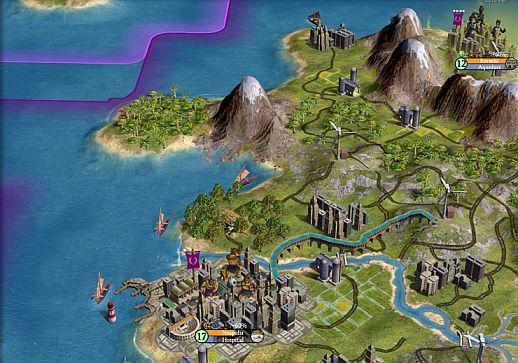
Thirdly, Civilization IV: Warlords the expansion pack to last year's Civilization IV had gone gold earlier in the month and was on its way to stores, on Wednesday, according to Futureshop.

The confluence of these three seemingly unrelated events was to set up for a pay-off of epic proportions. Well, ok, if you’re not me, it’s probably a bit trivial and not so epic, but it was a great day to be me this past Tuesday.

The week however did not start off so promisingly. Before the big payoff was the big bust. As I got home from work on Monday, I received a little slip from the postal service in my mailbox indicating I had a package. Unfortunately, the mailperson had not checked off if it the package was for Monday or if I had to go the next day to pick it up. Feeling certain I had received the package, I went to the post office to pick up the package with about half an hour to spare before the post office closed. About a dozen other people it seems also decided to show up at around the same time to do their postal business and what was supposed to be a quick entry and exit resulted in over twenty minutes of waiting, only to be told the package was not in and that it would arrive the next day.

My night would only get worse. Monday July the 24th was also the day Square-Enix patched Final Fantasy XI, adding new spells and abilities and adjusting several things, including the missions we were doing. Deeming it easier than originally anticipated, Square-Enix had decided to adjust downwards the points rewarded for completing the missions we were working on. As my friends and I proceeded to the mission, a sense of forboding came over us. We know they would be tweaking with the mission rewards and we wondered if ours were affected.

The mission went badly. We wiped, as in wiped-out (a FFXI slang for everyone in a party or alliance dying). But some quick last minute heroics saved the day. The Paladin used a re-raise item before dying, which allowed him to revive himself and raise me and the 3rd player. With the clock running, we had to complete it as fast as we could and in the end, we completed our assigned mission with only seconds to spare.

And then came the big disappointment. The adjusted points meant we did not have enough points (of the required 20,000) to trade-in and obtain our items. I came 7 points short of 20,000. Our plans were in ruins, but there was tomorrow, Tuesday.

And Tuesday came. After work, I went to the post office to pick up the package from the import store. Surprise, there was no line this time and with enough time to spare, I rushed off to Electronics Boutique to pick up an advanced copy of Civilization IV: Warlords which was supposed to be released in Canada on Wednesday but Ebgames managed to have early copies in stock.

As I worked to test out the Play-Yan Micro and have the first MP4 encoded files to play on it, it was time to complete our final mission before the item and unlike Monday, everything went smoothly and minutes after entering the arena for our mission, we stared the exit on the other end. As I rushed my avatar to the appointed place to collect my reward I could only think of how great the day was. I had gotten three things I’ve been waiting for and wanting in one day.

Tuesday was a great day indeed. And needless to say, I did not get much sleep that night.

P.S. This wasn’t released on Tuesday but I wish it was. A new and even more awesome Final Fantasy III trailer with a remix of the original FF III theme re-arranged by Nobuo Uematsu himself.

Saturday, July 15, 2006

The Art of Animation


When a piece of art, a movie, or a composition connects with you, there’s that electric moment of first contact. It is at the moment when you catch a glimpse of a film or hear the first notes of an artistic work and for a brief moment you feel pure bliss. The sensation is unfiltered and genuine. For that fraction of a second, you’re unjaded and become a kid again.

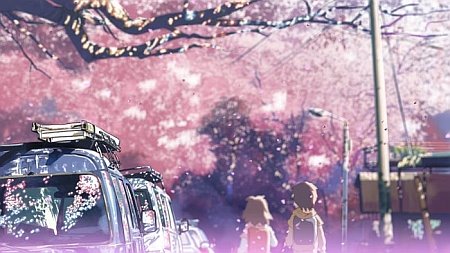
I had that electric moment when I watched the trailer to Makoto Shinkai’s latest project, 5 Centimeters Per Second. Click here to watch the trailer on youtube. Higher quality versions of the trailer can be found on the official website.


The trailer explains little, but as is common in Japanese dramatic works, it offers glimpses of ideas, emotions and quotes that connect with the story. The quotes which appeared in the trailer are translated below.

"Do you Know?"
"The Speed at Which Cherry Blossoms Fall…"
"5 centimeters per second."
"At What Speed Must I live…"
"…to be able to see you again."

The director’s notes translated courtesy of Daike at Makoto Shinkai Fan Web is edited for length and the English is polished.

"Byousoku 5 Centimeters (Speed of 5 Centimeters per Second)" is a serial short consisting of 3 independent works. The story at its core is about a boy set in Japan from the first half of the 1990s to the present day.

Sci-Fi or fantasy elements do not appear in this work. Our daily life rarely includes dramas, dramatic treachery or sudden revelations. Nevertheless, the world is filled with flavor and beauty and it is worth living.

We try to depict such an aspect of real life through this film...

-Makoto Shinkai


I am a big fan of Makoto Shinkai’s work and I have watched his first two commercial works, the short film, Voices of a Distant Star (reviewed here on my movie blog) and his feature film Beyond The Clouds also known as The Promised Place in our Early Days.

Shinkai came to prominence in the Japanese animation community in 1999 as an independent filmmaker. His first short She and Her Cat, youtube linked below, was a one-man project which he completed during his spare time off work at a major video game company. The short went on to win many animation awards in Japan and attracted the attention of a Japanese animation company CoMix Wave, the entity currently funding all of his projects.

What makes Shinkai’s films so watchable and endearing is the warmth of his subjects. They are young people with good intentions trying to live life the best they can in an often chaotic world. A common theme in his work is War and its impact on the young protagonists. His stories impart a nostalgic sense of yearning for a simpler time. They try to capture the purity and the good things found in the human experience. She and Her Cat explored the life of a cat and his owner, a young woman, through the eyes of her pet cat in the span of a year. Voices of a Distant Star dealt with a very simple high school love story while The Promised Place in our Early Days delved into the subject of 3 friends, a childhood promise made between them, and the aftermath of their lives when they go their separate ways.

Makoto Shinkai's [She and Her Cat] -Short-

Monday, July 10, 2006

Total War: Rome

One of the pleasures of picking up well-received PC games a year after its release is the ability to pick up their ‘Gold Editions’ which usually include the 1st expansion and a patched vanilla game and a substantial discount.

This is what I did with Rome: Total War. I’ve seen it on the shelves for some time, often retailing for as much as $60.00 Canadian last year. This past Wednesday, I walk into our local Future Shop with a mission to find this game. And luckily enough for me, there was one copy of the game left, and it was the Gold Edition, with the Barbarian Invasion included expansion for considerably less than the full priced versions of the vanilla game I saw on store shelves last year.

I’m no stranger to the Total War franchise. I had downloaded an early demo of Shogun: Total War several years ago and was impressed with its engine. In fact, when I bought my new computer in 2003, the first game I bought for it was Shogun, then already deeply discounted. Ultimately, Shogun: Total War was graphically impressive but slightly clunky, and it was still largely a twitch based RTS type strategy game with a glorified turn based campaign map tacked on.

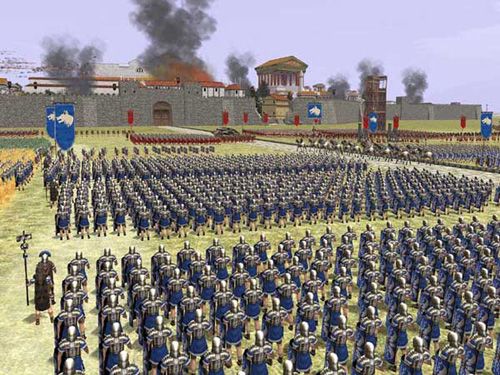
Rome is a vastly improved game. The campaign scenario is a fleshed out turn based strategy game in the vein of Risk or Sid Meier’s Civilization games, while the individual battles themselves are in real-time. The player are then given the option to either auto-resolve battles or to fight them out and similarly on the macro side of empire management, players can also choose to automate all their cities and focus only on moving armies and fighting. This gives players a range of choice on how to manage their factions in the campaign game.

No game has married the strategic scale of a turn-based game with the tactical nature of RTS games as well as Rome: Total War has done. As someone who enjoyed games like StarCraft more for its co-operative play, rather than the frantic nature of a typical RTS death match game, I really appreciate the real-time strategy battles in this game. Fast movement is replaced with realistic movement. There is even a pause button for players to pause the game and give their individual units commands. And the real-time battles themselves play out realistically. Ordering a unit of Centurions to march from the left flank of my battle line to the right will take time, even if they are running at full speed.

Further more, unlike your typical history based RTS games such as the Rise of Nations and Age of Empires games, the separation between a campaign map and a tactical battle map also separates economic (macro) empire management from tactical battle management. Fighting a battle then having to zoom across the map to ‘home base’ to move idle workers to a logging point is a non-issue in Rome. I could only wish more RTS games masquerading as history simulations should take note.

The realism injected into the battles result in very well paced battles and the tactical nature of the fight itself is enhanced. Instead of degenerating into a mass of units dying, there is still a lot of management that can be done even when the bulk of two armies clash. Rarely do I find myself struggling to command my units, as is usually the case with most RTS games, when there are too many units to manage and too much going on.
Supported by an impressive 3-D engine and an epic Hans Zimmer inspired soundtrack by composer Jeff van Dyck, the battles themselves become a kind of beautiful cinematic experience of battle formations, clashing melee units and cavalry charges. Students of history will appreciate this game for giving them a view and control into one of the great epochs of history, despite some obvious deviations from history.


Friday, June 30, 2006

Trans-Mars-Rover


What a disappointment. I’ve waited months to see the sneak preview to the upcoming Transformers Movie and we get something that looks like it is the teaser to another passable sci-fi action flick from Michael Bay.
Ok well, this may end up being just that, but still, this is THE TRANSFORMERS live action movie! What do we get? Half the trailer is spent setting up the premise that UK based Beagle 2 Mars Rover (totally made up) was destroyed by robots on Mars. The real Beagle 2 was not a rover but an immobile probe that was sent to Mars in 2003 by the British and was lost, supposedly when it crashed on to the surface.
What’s worse, they cut in re-enacted visuals of NASA’s famously successful Mars Exploration Rovers (MER) as it drives off its mothership before it is smacked to pieces by what appears to be Optimus Prime himself, although I could be mistaken. We get it, the MER Rovers were indeed transformable robots that were sent to Mars folded up and transformed into their working configuration on the Mars surface. Great allusion there, but Bay beats us over the head with it. After destroying the history of the Pearl Harbor attack, he has now managed to bastardize another facet of history, and a fairly recent one at that.
You know, I could have forgiven the factual inaccuracies had the trailer not spent the whole time setting up a War of the Worlds scenario of yet another imminent threat from Mars as its first big tease to the viewing public. The CG visuals were certainly stunning and the recreation of the Mars rovers on Mars was nothing short of spectacular. I would pay to watch a realistic Kubric-esque movie about Mars with those visuals. But this isn’t a Kubric film, it’s a Bay joint and he can’t even give us any action. Furthermore, I was waiting and waiting for the vintage Transformers chorus from the television series to cap off the trailer. That would be a real tease to the fans. Maybe even a close-up of Optimus Prime himself in silhouette with his eyes glowing steel blue in true Japanese anime style. Nope, we get a bad teaser that is factually inaccurate, with absolutely nothing to excite the legions of fans that grew up with this venerable animated series.
Michael Bay and Paramount... you suck!


Friday, June 23, 2006

Miyamoto's Dark Side

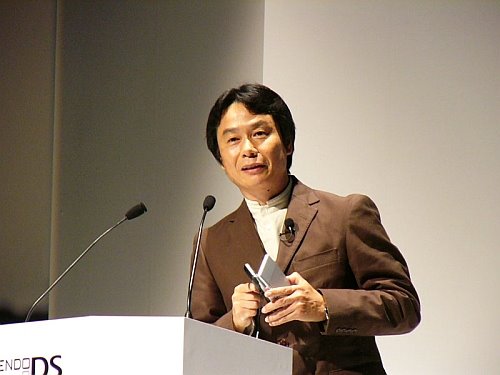
Nintendo's Shigeru Miyamoto
photo courtesy of Impress Group Company


Next-Generation has a very interesting editorial discussing this very issue. The topic at hand is Shigeru Miyamoto’s influence on gaming. On the balance, most of us can agree his influence is certainly positive, but a question often not asked is has his presence in the industry brought negatives to the table. More bluntly, it asks: ‘is Miyamoto's influence universally good?’

The answer, according to the author, is No.

“Miyamoto is, at heart, a children's book author…” and he “was virtually put in charge of the most powerful videogame company on Earth,” writes Next-Generation’s Eric-Jon Rossel Waugh.

His vision “was the only significant voice within Nintendo. In the wake of Miyamoto's success, everyone else was put on standby,” adds Jon Rossel Waugh. And here in lies the problem. The Miyamoto’s way became the only way. “This aesthetic, this mentality, this rulebook became – through Nintendo's mantra, in absence of any mainstream alternative (except maybe Sega)… Nintendo's system was seen as nice, and certainly impressive on the technical end, yet sort of stodgy. Sega had games no one had played before – or not exactly, anyway. Nintendo getting Street Fighter II before Sega did a little to knock that impression.”

The author is right in pointing this out. The industry certainly doesn’t work that way, and alternatives are arrived at and explored by other developers everyday. Will Wright may share Miyamoto’s sensibilities and philosophies but Miyamoto could not have made Sim City, only Wright could have. The implication made is that Nintendo had in many ways experienced a decade of decline since the end of the 16-bit generation largely because of Miyamoto. This is a shocking twist, but there is certainly a point to be made.

I would however made a big distinction between the above argument with what the author proceeded to do in the rest of his editorial, which was to make mostly questionable and arguable claims about how adherence to the Miyamoto formula kept innovation in gameplay form happening. Here is a short list of his claims: Super Mario World is a retread of Supwer Mario 3 [Well ok, I sort of agree since I loved Mario 3 much more than I did Mario world]; Zelda – A Link to the Past is a remake of Zelda 1; Zelda Ocarina of Time could have been made on the a 2-D platform, even a GameBoy.

The author’s point here is an attempt to connect his premise that Miyamoto’s overwhelming success and entrenchment within Nintendo caused a kind of ‘freezing’ which brought about repeated retreads and remakes of the same game. According to Rossel Waugh, Zelda essentially hasn’t changed since the first game.

I can’t say I agree in this regard, and this may have been a case of over-reach on the author’s part to grasp at connections that doesn’t exist. The Zelda franchise is great because in part, it has maintained firmly rooted in the concepts and conventions created in the original, but it is certainly by no means frozen in time because of a desire to stick with the Miyamoto system.

Ultimately Rossel Waugh lost the point he was trying to make in the first part of his editorial and opened the door for the discredit of his entire position. Miyamoto can’t be all things to all people. He has a special ability to make universally appealing games of a certain type. The mythical ‘virtual gardens’ that he spoke of in past interviews, is what he strives to recreate in almost all his games. Each game has its internal logic, based not on reality but on game rules. But within that game, the logic makes sense and is wholly consistent. This however doesn’t define what ALL games are about. Nintendo’s problem, and Miyamoto’s contribution to that problem, at least in the last 10 years, was precisely because management at Nintendo had deemed Miyamoto so powerful that they built the company’s strategy around the type of games Miyamoto either designs and oversees personally or games that follow his method of game design.

There are alternatives out there. In an era of increasing stagnation and sequel-itis, Nintendo is attempting to find its way back into the center of the limelight by reinventing the way it makes games. Case and point, Miyamoto was either only marginally involved or had no involvement at all in the creation of some of the platform's killer-apps: Animal Crossing, Brain Training, Nintendogs, to name a few. More convincingly, many more 3rd party games that give the DS such a strong identity and differentiates it from the PSP are not Nintendo games. They are games from third parties. Games like Capcom's Phoenix Wright Ace Attorney, Atlus' Trauma Center, Konamis' Castlevania Dawn of Sorrow and Winning Eleven; Bandai Namco's Kaitou Rusoo, SquareSoft's Children of Mana and the upcoming Final Fantasy III are all outside of the Miyamoto school. Quite simply, Nintendo has proven, after a decade of self-doubt, that its good to have Miyamoto on the team, but one man can't make a game console.

Saturday, June 17, 2006

Fantasies are Never Final

... and blogs are never truly abandoned. A lot has happened since my last post but rather than bore people with accounts of the past, here are a few things on my mind at this point in time in no particular order and no particular significance. These are just things that I thought worthy enough to mention.

DSLite - I liked the original DS, but many people complained about the screen vis-à-vis what the PSP had and the bulk of the unit. The lite is less bulky compared to either the PSP or DS and has an even better screen than the PSP, with 4 brightness settings. Well, there’s still one thing people can moan about. The lack of texture filtering, not that its going to stop the next item in my list from looking like a million dollars.


Final Fantasy III – Awesome graphics, and old school RPG back in play. This is based on the original Final Fantasy III (not the III released in North America). The trailer released during E3 had a good mix of cinematics, in-game shots and an awesome musical score.

The trailer is awesome. Sale +1.

Oliver Stone’s World Trade Center - The trailer for World Trade Center had me chocked up. The cynic would say its propaganda or whatever. But you know, people actually died that day and a lot of them were regular ‘working folk’ who was doing their job and put themselves in danger to save other people, some of them were actually Canadians!

The trailer seems to follow the Hollywood formula for this kind of movies, sentimental, with a sappy theme that suits the long camera pans and slow motion shots of the main characters looking serious. Thanks to the power of computer graphics, the trailer already show in stunning detail, the New York skyline on September 11 2001, complete with a Zoolander billboard (LOL). What hit home for me is that unlike JFK or Nixon both of which chronicled events which occurred before I was born, this movie is about an event which occurred only a few years ago, in my young adulthood and it’s not quite the same movie as the other two. It’s more real and immediate to me.


Final Fantasy XI - I started this blog by quitting the game, but I returned to it soon after my final post last October. I’m still enjoying it, although I stick mostly to a few good friends as we work towards our desired items. I could elaborate but it would sound about as foreign to the uninitiated as Japanese did to Bill Murray’s character in Lost in Translation, so I won’t. Suffice to say, I recently came into an item I never thought I would own. It’s something that was too expensive and difficult for me to get in my two years playing as a White Mage. I finally got an Errant Cape: 9 Defence 30 mp -5 enmity 73 Lvl. Boo-yah!

Monday, October 24, 2005

One More Turn of Civilization


In a few hours, I should be sitting at home losing myself inside the world of Civilization IV. Fall and Civilization addiction has been a tradition for me for quite a few years now as Firaxis has had a penchant of releasing Civilization games and its expansion packs in three of the last four years during the October-November frame.

This fall I get to play with a new game. But it’s actually not all that new to me at all. I was lucky enough to have been invited by Firaxis to help test the game in its early stages and give them feedback. Although I was ultimately not able to participate as fully as I had hoped, what I saw in the few months around May and July excited me. This is why I’m so eager to get my hands on the completed final build and to continue giving feedback back to Firaxis in the post-release phase and beyond.

Playing Civilization games is an all-consuming passion for me. Like the history of civilizations, my passion waxes and wanes with time. I’m not always playing the games, but I am always a fan. Being a fan of Civilization is a bit like being a fan of a sports team. It’s an obsession in itself especially when the season is open and every other fan is going crazy. In the many active on-line communities, players debate over strategy, unit strengths and game balance in the same way a sports fan would talk about rival line-ups and play fantasy leagues. Others pour in countless hours of testing to discover the underlying mathematical algorithms that govern the games functions, and still others play the games in ways that push the boundaries of strategy and applying realpolitik into the game world.

Players also invest time into creating elaborate historical accounts of their games. Some are so well written that they rival in scope if not in quality real history texts. What these historical after-game-reports accomplish is in their ability to humanize the game’s many actors. The traditional Civilization game is a solitary single player experience played against a complex if ultimately predictable artificial intelligence where individual turns may take as long as an hour to complete. By putting the game into prose, the gamers give life and context to these game turns.

Rather than a series of uninteresting moves and countermoves between the player and the AI, the turns emerges as a story about clashing ambitions of rival nations fighting over pieces of land and resources, attempts at containment, alliances, cold wars, hot wars, historical enmities and the rise and fall of civilizations itself. These stories mirror real history but one that is taking place in a virtual planet.

In Civilization, players finish their games with a real sense of accomplishment. This isn’t Pinky and the Brain ‘conquer the world’ stuff. This game allows players to do immense good by unifying peoples, create great wealth, build wonders of the worlds and hold together a genuine lasting peace for eons, the likes of which our world has never seen. On the same coin, it also allows players to do immense evil.

Ultimately it is also about where the player’s intentions ultimately lay. The game certainly cannot recognize the subtle difference between abstract human concepts such as a warmongering player that rampages through neighbours in search of ultimate power, a peaceful defensive builder or a pragmatic player seeking to ‘win’ and grant its people prosperity and peace through limited wars and aggressive diplomacy. These are concepts only the human players can understand and apply in their games.

The wide-open nature of Civilization is its true genius. It allows players an open canvas in which they can repaint and reshape history in their own unique ways. Perhaps, in a small way, it also satisfies a little bit of the player’s own hubris. Everyone of us have a need to take control and to do what we consider is ‘good’ in our own way, rather than petitioning far off politicians or casting an insignificant vote in the electoral system. In Civilization, the players command populations, economies and armies. When all is said and done, the most successful players hold the fate of hundreds of millions of people in their hands. These may be mere numbers on the computer screen, but did Alexander, Emperor Qin, Caesar and Salahadin see their civilizations any differently? Theirs were also a civilization of numbers.

Monday, October 17, 2005

Nintendogs Day 4


Nintendogs is a great game. As I noted in my earlier post, the game sold 200,000 units in its first week in North America, it sold a further 250,000 units in all of September, putting its cumulative total on September 31st at 450,000 units sold. In Japan the game’s sell through is fast approaching 700,000 units and the game did reasonably well in Europe after its late launch with 150,000 units sold.

I was lucky enough to not only be alive but mentally cogent and aware when Bandai’s Tamagotchi virtual pet craze swept through North America in the late 90s. Heck, I actually had one of those things, or it could have been a cheap knock off…well it doesn’t matter. The point is virtual pet games have been a mainstay for many years now.

It’s surprising that after all these years, virtual pet sims can still surprise us when many thought the fad had passed. I was never big on the virtual pet phenomenon the first time around and for me it was the simple reason of design. The first generation of virtual pets were dumb, stupid and got boring quickly. My Tamagotchi pet went uncared for after about two days, and the Dogs and Cats type PC virtual pet games looked interesting but were more like advanced versions of Tamagotchi games, only with prettier graphics.

This brings me back to my opening paragraph. Why all this interest in a dog/pet simulator now? The answer is quite simple. Nintendogs isn’t a cheap high margin $30 toy. Nor is it a half hearted one-sized fits all PC game that tries to shoehorn the concept of a virtual pet game into an existing platform.

Nintendogs is built for the Nintendo DS. The two native features on the DS, the touch screen and the microphone makes a world of difference. Players no longer need to learn complicated button combinations to access the right menu to play, pet or feed their pets. With Nintendogs, what you see is what you get. If I see the dog, I can reach out pet it with the stylus. Rather than accessing a command to call the dog to attention, players call out the dog’s name.

And the voice recognition aspect of the game the real deal sealer for me. While the voice recognition software is far from perfect, it works well. The dog will learn the user’s voice and learn its name after a few tries. A few days on, even the slightest call will get the dog to react to its name and it will leap happily towards me.

The harder part is getting it to recognize all the different commands for tricks and getting it to remember everything. This may be due in part to the built-in mic being place slightly off centre while the natural tendency of the player is to speak to the puppy face to face. The programmers at Nintendo also implemented a nice ‘real-life’ dilemma to players. Rather than having a robot dog for a pet where everything taught is learned and mirrored, the dogs in Nintendogs forget tricks, mix them up, and will sometimes stubbornly refuse to participate in training when they are tired or hungry.

For me, the greatest innovation with Nintendogs isn’t the idea of the virtual pet, but rather the idea of a virtual life living inside a bundle of chips, motherboards and electrons. This effect on the heart and brain is something the clunky Tamagotchi and the first generation virtual pet software never truly achieved. Nintendo had really nailed down the illusion of a real living pet with in this game, sans the physical touching, although the touch screen is a welcome substitute.

And for all the flack Nintendo get about how the DS is underpowered, Nintendogs is a great game to play and look at. The 3-D world is silky smooth, perfectly textured and dare I say beautiful. It is all seen through the dog’s eye view of course. The dogs are slightly stylized but look realistic and do not betray the real puppies they are based on. It is also clear Nintendo designers studied real dogs to capture how they play, sleep, react to toys and even how they go to the toilet. Everything is modeled with a kind of whimsy and realism that makes coming home to the game such a great thing. And finally, the game isn’t time consuming. Fifteen minutes here and there is enough to maintain a healthy dog and keep the dog trained for the game’s various competitions.

Monday, October 10, 2005

ROME Episode VII: Pharsalus

It has been several weeks since I wrote a review of HBO’s Rome.  That’s not to say I have lost interest.  In the weeks since my last entry, HBO announced ROME  would be renewed for a second 12 episode season and the first season of the show is moving along quite nicely.

I have to admit though at being at little disappointed with the overall direction of the series.  I don’t mean it as a deal breaker in terms of my liking of the show.  It is by all accounts, superior to pretty much every single recent historical epic put on film, and nothing on TV, save HBO’s Band of Brothers comes close to it as a historical drama.

That said, ROME suffers from a bit of an identity crisis.  On one hand, there are these great historical figures and giant battles that were fought between Pompey and Caesar.  And on the other hand, you have the two fictional characters of Vorenus and Pullo that has a more personal dramatic story.  The creators were going for the right mix of drama and historical storytelling.  In Band of Brothers, they ignored the historical giants of the time and focused on a company of soldiers.  In ROME, they try to focus on both aspects of the story.

On some episodes, especially the last couple of episodes leading up to Episode VII, I thought they had done a decent job of balancing the grand historical events and the fictional drama.   However, after all the pent up anticipation for the decisive battle, it is not shown in Episode VII.  It is rather anti-climactic that the episode entitled Pharsalus, doesn’t show the battle of Pharsalus, but rather the events right before and after the battle.

I was hoping for this show to be dedicated to showing the duel between Caesar and Pompey.  There needn’t be lots of digital ants and elaborate scenes where thousand men extras march towards war.  But Pharsalus itself was a battle where Pompey had a decisive advantage in military men and it had looked like he was going to win.  How he lost that advantage and how things went so wrong for him is important.  There is certainly abundant human drama to be told in the battle itself.  A series of vignettes showing Caesar and Pompey making the strategic choices on the battlefield, their reactions to each other and the ultimate outcome are things this episode missed out on.